
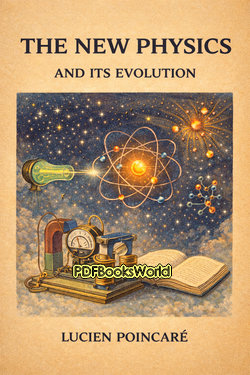
The New Physics and Its Evolution
by Lucien Poincaré
Modern Physics, Scientific Revolution, and the Changing Understanding of Reality
The New Physics and Its Evolution by Lucien Poincaré is a fascinating exploration of the dramatic scientific changes that transformed physics during the late nineteenth and early twentieth centuries. The book examines the revolutionary discoveries that challenged traditional mechanical views of the universe and introduced entirely new ideas concerning matter, energy, electricity, radiation, and the structure of physical reality.
Poincaré presents modern physics as a rapidly evolving intellectual revolution in which older scientific certainties were being replaced by deeper and more complex understandings of nature.
The Collapse of Classical Certainty
The book discusses how discoveries involving X-rays, radioactivity, electrons, electromagnetic theory, and atomic structure forced scientists to reconsider long-established assumptions about matter and physical law.
Poincaré explains how classical mechanical physics, once believed capable of explaining all natural phenomena, began encountering limitations when confronted by new experimental evidence.
He also explores the growing importance of energy theory, atomic investigation, and electromagnetic phenomena in reshaping scientific understanding of the universe.
Rather than presenting science as complete and settled knowledge, the work reveals physics as a dynamic and continually changing field driven by observation, experimentation, and theoretical innovation.
The volume reflects the intellectual excitement surrounding one of the greatest scientific transformations in modern history.
Its tone combines scientific explanation with philosophical reflection and admiration for human inquiry.
Scientific Ideas and Themes Explored Throughout the Book
- The Decline of Classical Mechanics: Poincaré examines how traditional physical theories were challenged by new discoveries.
- Electricity, Radiation, and Atomic Structure: The book explores emerging knowledge concerning electrons, radioactivity, and invisible physical processes.
- Energy and Electromagnetic Theory: Modern physics increasingly emphasized energy and fields rather than purely mechanical models.
- The Evolution of Scientific Knowledge: The work demonstrates how science changes through experimentation and revision of accepted ideas.
The book captures physics during the crucial transitional period immediately preceding relativity and quantum mechanics.
A Universe More Complex Than Previously Imagined
One of the work’s strongest ideas is that scientific progress often reveals reality to be far more subtle and mysterious than earlier theories suggested.
Poincaré repeatedly demonstrates how discoveries concerning radiation, electricity, and atomic behavior challenged humanity’s traditional understanding of matter itself.
The book also emphasizes that scientific revolutions rarely destroy knowledge entirely, but instead deepen and transform earlier understanding.
This balance between scientific uncertainty and intellectual optimism gives the work lasting philosophical significance.
Lucien Poincaré’s Clear and Reflective Scientific Style
The New Physics and Its Evolution demonstrates Lucien Poincaré’s ability to explain difficult scientific developments in language accessible to educated general readers.
The writing remains analytical, thoughtful, and strongly focused upon the broader intellectual implications of modern physics.
Poincaré consistently presents science as a living process of discovery shaped by questioning, experimentation, and theoretical imagination.
Why the Book Still Holds Importance Today
Modern readers continue finding The New Physics and Its Evolution historically valuable because it captures the moment when classical physics was giving way to the revolutionary scientific ideas that shaped the twentieth century.
The book also provides insight into how scientists and intellectuals interpreted the emerging discoveries that eventually led to relativity, quantum theory, nuclear physics, and modern cosmology.
For readers interested in physics, scientific history, philosophy of science, electromagnetism, atomic theory, and the development of modern scientific thought, this work remains intellectually rich, historically revealing, and deeply thought-provoking.
Similar Genres
About the Author
Lucien Poincaré was a French physicist, science administrator, educator, and author who played an important role in promoting scientific education during the early twentieth century. A distinguished scholar and the brother of the renowned mathematician Henri Poincaré, he devoted much of his career to explaining the rapid advances taking place in modern physics. Explore Lucien Poincaré books to discover the author's life, literary career, and access notable works.