
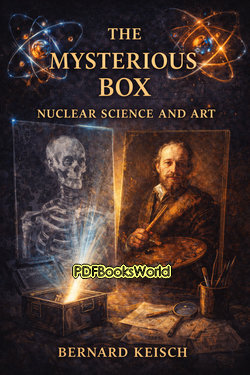
The Mysterious Box: Nuclear Science and Art
by Bernard Keisch
Exploring the Atomic Age Through Science and Imagination
The Mysterious Box: Nuclear Science and Art by Bernard Keisch is an intriguing work that seeks to make the complex world of nuclear science accessible to a broad audience. Combining scientific explanation with imaginative storytelling and artistic perspectives, the book introduces readers to the discoveries that transformed humanity's understanding of matter, energy, and the structure of the universe.
Written during an era when nuclear science captured public attention, the work reflects both the excitement and the curiosity surrounding atomic research. Walton presents scientific concepts in a manner designed to engage readers who may have little technical background, demonstrating how art and imagination can help illuminate difficult subjects.
The result is a fascinating blend of education and creative interpretation.
The Meaning of the "Mysterious Box"
The title serves as a metaphor for the hidden world within the atom. For centuries, the fundamental nature of matter remained largely unknown. Scientific advances gradually revealed that even the smallest particles contained extraordinary complexity and immense stores of energy.
Walton uses the image of a mysterious box to symbolize humanity's efforts to unlock nature's secrets. Each scientific discovery opens new questions, inviting further exploration into realms previously beyond human understanding.
This sense of wonder is central to the book's appeal.
Introducing Nuclear Science
A major goal of the work is to explain the basic principles of nuclear science in clear and understandable language. Rather than focusing solely on technical details, Walton emphasizes the ideas behind the discoveries.
- The structure of atoms.
- The nature of atomic energy.
- Radioactivity and nuclear reactions.
- The scientific methods used to study matter.
By presenting these topics through accessible examples and illustrations, the book encourages readers to appreciate the significance of modern scientific research.
Where Science Meets Art
One of the most distinctive features of the book is its effort to connect scientific ideas with artistic expression. Walton suggests that both scientists and artists share a common desire to understand and interpret the world.
Science seeks explanations through observation and experimentation, while art communicates understanding through imagery, symbolism, and creativity. By bringing these perspectives together, the book demonstrates that complex scientific ideas can become more meaningful and memorable when approached imaginatively.
This combination broadens the appeal of the subject beyond traditional scientific audiences.
The Impact of the Atomic Age
The development of nuclear science profoundly influenced twentieth-century society. New discoveries transformed medicine, industry, energy production, and scientific research while also raising important ethical and political questions.
Walton explores the sense of possibility that accompanied these developments. The atom appeared to offer unprecedented opportunities for progress, yet it also reminded humanity of the responsibilities that accompany powerful new knowledge.
This dual perspective reflects the optimism and caution that characterized public discussions of nuclear science during the period.
Bryce Walton's Educational Approach
Bryce Walton was known for presenting complex subjects in engaging and accessible ways. In this work, he combines factual information with a narrative style that encourages curiosity rather than intimidation.
Instead of overwhelming readers with technical terminology, he focuses on the broader significance of scientific discoveries and the excitement of exploration. His approach helps transform abstract concepts into ideas that readers can visualize and appreciate.
This emphasis on understanding makes the book especially effective as an introductory work.
The Enduring Fascination of Scientific Discovery
Although scientific knowledge has advanced considerably since the book was written, the themes it explores remain relevant. Humanity continues to investigate the fundamental nature of matter, energy, and the universe itself.
The sense of wonder inspired by discovery has not diminished. Scientific breakthroughs still challenge assumptions and expand our understanding of reality, much as they did during the early years of the atomic age.
The book reminds readers that curiosity remains one of the most powerful forces driving human progress.
Final Thoughts
The Mysterious Box: Nuclear Science and Art by Bernard Keisch is an engaging exploration of atomic science presented through a combination of education, imagination, and creativity. By connecting scientific concepts with artistic perspectives, Walton makes a challenging subject approachable while preserving the excitement of discovery.
For readers interested in science communication, the history of the atomic age, and the relationship between scientific inquiry and creative thought, this work offers a thought-provoking and enjoyable introduction to one of the most transformative fields of modern knowledge.
Similar Genres
About the Author
Bernard Keisch was an American physicist, educator, and science writer whose work sought to make complex scientific ideas understandable to general readers. Drawing upon his background in nuclear science, Keisch believed that scientific knowledge could be communicated through clear language, creative examples, and imaginative presentation. Explore Bernard Keisch books to discover the author's life, literary career, and access notable works.