
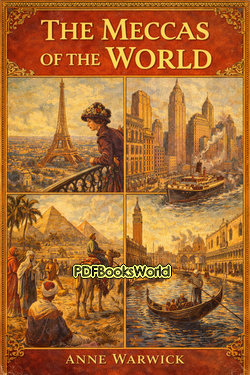
The Meccas of the World
by Ruth Cranston
Five Great Cities, Five Different Visions of Modern Life
The Meccas of the World by Ruth Cranston is a fascinating travel and social commentary that examines life in some of the most influential cities of the early twentieth century. Rather than focusing solely on famous landmarks or tourist attractions, Cranston explores the character, culture, and daily experiences of urban life in New York, Paris, Vienna, Madrid, and London. Through keen observation and thoughtful analysis, she presents these cities as centers of aspiration, creativity, and social change.
The title uses the word "Meccas" not in a religious sense, but as a way of describing places that attract people seeking opportunity, culture, excitement, and personal fulfillment. Each city becomes a stage upon which modern life unfolds, revealing both its promises and its contradictions.
New York: A City in Constant Motion
Cranston begins with New York, portraying it as a bustling and energetic metropolis filled with ambition and activity. She looks beyond popular stereotypes to examine the lives of ordinary residents, from workers and shopkeepers to professionals and social leaders. The city appears as a place where dreams are pursued with determination, yet where significant social and economic contrasts also exist.
Her observations highlight the excitement and challenges of urban growth, presenting New York as a symbol of modern ambition and relentless movement.
Exploring Europe's Cultural Capitals
As the journey continues, readers are introduced to several major European cities, each with its own distinct personality. Paris is portrayed as a center of style, culture, and artistic expression. Vienna reflects a unique blend of tradition and refinement, while Madrid offers insight into a society balancing historical heritage with changing times. London, meanwhile, serves as a powerful example of a city shaped by history, commerce, and global influence.
By comparing these cities, Cranston reveals the diversity of urban experiences and the different ways societies respond to modernization.
Major Themes Found Throughout the Book
- Urban Life: The opportunities and challenges created by large cities.
- Cultural Identity: How cities develop distinctive personalities and traditions.
- Social Change: The effects of modernization on everyday life.
- Human Aspirations: The hopes and ambitions that draw people to major population centers.
These themes connect the various chapters and help readers understand the broader purpose behind Cranston's observations.
A Portrait of the Early Twentieth Century
One of the book's greatest strengths is its ability to capture a specific moment in history. The cities described are experiencing rapid change, influenced by new technologies, shifting social attitudes, and growing international connections. Readers gain a valuable glimpse into how people lived, worked, and interacted during this transformative period.
The book serves not only as a travel narrative but also as a historical record of urban society before many of the dramatic events that would reshape the twentieth century.
Ruth Cranston's Observational Style
Cranston writes with curiosity and attention to detail. Rather than presenting dry facts, she focuses on the atmosphere and character of each location. Her descriptions help readers imagine crowded streets, lively public spaces, and the everyday routines that define city life.
This approach makes the book engaging for both travel enthusiasts and readers interested in social history. The author's observations often reveal as much about people as they do about places.
What Makes the Book Stand Out
- International Perspective: A comparative look at major cities across two continents.
- Social Commentary: Insight into the lives and attitudes of urban populations.
- Historical Value: A snapshot of city life in the early 1900s.
- Accessible Writing: Clear observations that remain engaging for modern readers.
Why The Meccas of the World Remains Interesting Today
The Meccas of the World continues to appeal to readers because it combines travel writing, cultural observation, and historical insight. Through her exploration of New York, Paris, Vienna, Madrid, and London, Ruth Cranston captures the energy and complexity of urban life during a period of remarkable change. The book offers a thoughtful look at how great cities shape the people who live in them and why they continue to attract dreamers, artists, workers, and travelers from around the world.
Similar Genres
About the Author
Ruth Cranston was an American author, journalist, and travel writer whose works introduced readers to remarkable places, cultures, and spiritual traditions around the world. With a talent for combining historical research, firsthand observation, and engaging storytelling, she explored destinations that held deep cultural and religious significance. Explore Ruth Cranston books to discover the author's life, literary career, and access notable works.