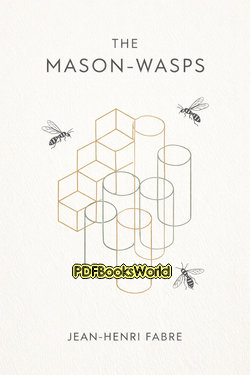
The Mason-Wasps
by Jean-Henri Fabre
The Fascinating World of Nature’s Skilled Insect Builders
The Mason-Wasps by Jean-Henri Fabre is an engaging work of natural history that explores the lives and behaviors of one of the insect world's most remarkable architects. Through careful observation and vivid descriptions, Fabre reveals how mason-wasps construct their nests, care for their young, and survive in the natural environment. The book combines scientific inquiry with storytelling, making complex biological behaviors accessible and interesting to readers of all backgrounds.
Meet the Mason-Wasp
Mason-wasps are known for their extraordinary nest-building abilities. Using mud, clay, and other natural materials, they create protective structures that serve as homes for their developing offspring. These carefully crafted nests demonstrate a level of precision and instinct that has fascinated scientists and nature enthusiasts for generations.
Fabre’s Method of Observation
Unlike many researchers of his time, Jean-Henri Fabre preferred to study insects in their natural surroundings. He spent countless hours observing their habits, recording details, and conducting simple experiments to better understand their behavior. This approach allowed him to uncover insights that traditional laboratory studies often overlooked.
Remarkable Behaviors Explored in the Book
- Nest Construction: Mason-wasps build durable structures using natural materials.
- Parental Care: The insects prepare food and shelter for their offspring.
- Instinctive Precision: Complex tasks are performed without formal learning.
- Adaptation: Different species develop strategies suited to their environments.
The Science Behind Instinct
One of the book’s most intriguing topics is the role of instinct in animal behavior. Fabre examines how mason-wasps perform highly organized activities despite having no opportunity for training or instruction. Their actions raise important questions about intelligence, inherited behavior, and the natural mechanisms that guide living creatures.
Major Themes in the Book
- Nature’s Complexity: Small insects display surprisingly sophisticated behaviors.
- Scientific Curiosity: Observation is essential to understanding the natural world.
- Instinct and Behavior: Many actions are guided by inherited patterns.
- Adaptation: Species evolve effective survival strategies.
- Respect for Wildlife: Every organism contributes to the richness of nature.
Jean-Henri Fabre’s Lasting Influence
Fabre is widely regarded as one of the pioneers of modern entomology. His ability to combine scientific accuracy with engaging narrative helped make the study of insects accessible to a broader audience. His observations continue to be admired for their detail, patience, and appreciation of the natural world.
Why the Book Remains Valuable Today
The Mason-Wasps continues to captivate readers because it demonstrates how much can be learned from even the smallest creatures. Fabre’s work encourages curiosity, careful observation, and a deeper appreciation of the complexity of life. For readers interested in insects, ecology, or natural history, the book offers an enlightening journey into the remarkable lives of nature’s tiny builders.
Similar Genres
About the Author

Jean-Henri Fabre was a pioneering French naturalist, entomologist, and author whose remarkable observations transformed the study of insects into engaging literature. Born in 1823 in southern France, Fabre possessed an extraordinary curiosity about the natural world and spent decades patiently observing the behavior of insects in their natural habitats. Explore Jean-Henri Fabre books to discover the author's life, literary career, and access notable works, including The Life of the Grasshopper, The Sacred Beetle, and Others, The Life of the Scorpion, Animal Life in Field and Garden , and more.