
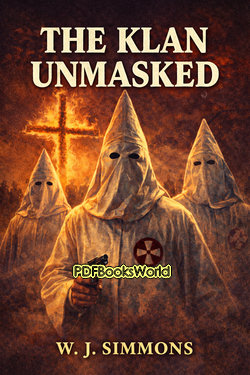
The Klan Unmasked
by W. J. Simmons
Examining a Controversial Chapter in American History
The Klan Unmasked by W. J. Simmons is a historical work that focuses on one of the most debated organizations to emerge in the United States after the Civil War. Written during a period when memories of Reconstruction were still influential, the book seeks to explain the origins, activities, and public perception of the Ku Klux Klan. Today, the work is primarily valued as a historical source that reflects the viewpoints, attitudes, and controversies of its time.
Readers approaching the book encounter not only a discussion of a specific organization but also a window into the political and social tensions that shaped the American South during the late nineteenth century. As with many historical works, understanding its context is essential for appreciating its significance and limitations.
The Historical Background
The period following the American Civil War was marked by profound change. Former Confederate states faced political reconstruction, economic challenges, and social transformation. Questions about citizenship, voting rights, government authority, and racial relations created intense debates throughout the nation.
Within this environment, various groups emerged that sought to influence political and social developments. Simmons examines the rise of the Ku Klux Klan and its place within the broader struggles of the Reconstruction era. The book reflects contemporary attempts to interpret events that remained highly controversial even decades after they occurred.
Topics Covered in the Book
The author explores several subjects connected to the organization and the period in which it operated.
- Post-Civil War America: The political and social conditions that followed the conflict.
- Reconstruction: Government efforts to rebuild and reorganize Southern states.
- Public Perception: How different groups viewed the Klan and its activities.
- Political Conflict: The competing interests and ideologies that shaped the era.
- Historical Interpretation: Efforts to explain complex events and movements.
A Reflection of Its Time
One of the most important reasons scholars study books like The Klan Unmasked is that they reveal how people of a particular era understood their own history. Historical works are often shaped by the beliefs, experiences, and assumptions of their authors. As a result, modern readers frequently examine such texts alongside other sources to gain a fuller understanding of the period.
The book therefore serves not only as a narrative about Reconstruction but also as evidence of how historical memory was formed and communicated in the late nineteenth century.
Major Themes Explored
- Historical Memory: How societies remember and interpret past events.
- Political Change: The challenges of rebuilding a nation after conflict.
- Social Division: The difficulties created by competing interests and beliefs.
- Identity: The role of regional and political loyalties in shaping perspectives.
- Interpretation of History: The importance of examining multiple viewpoints.
Understanding Historical Sources
Modern readers often approach historical texts with an awareness that every source reflects a particular perspective. Books written close to the events they describe can provide valuable firsthand insights, but they may also contain biases and assumptions that require careful evaluation. This makes critical reading an essential part of studying history.
By comparing different accounts, readers can better understand the complexity of historical events and the ways in which interpretations evolve over time.
Why the Book Remains Relevant
The Klan Unmasked continues to attract interest from historians, students, and readers interested in American history because it offers insight into the debates and perspectives of the Reconstruction era. While modern scholarship often approaches the subject from broader and more diverse viewpoints, works such as this remain important historical documents.
As a reflection of its time, the book contributes to discussions about historical memory, political conflict, and the challenges of interpreting the past. For readers interested in the complexities of post-Civil War America, it provides an opportunity to examine how earlier generations understood one of the nation's most turbulent periods.
Similar Genres
About the Author
Walter J. Simmons, commonly known as W. J. Simmons, was an American Baptist minister, educator, historian, and author whose writings focused on African American history, education, and public life during the late nineteenth century. Explore W. J. Simmons books to discover the author's life, literary career, and access notable works.