
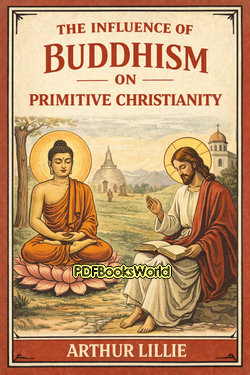
The Influence of Buddhism on Primitive Christianity
by Arthur Lillie
Exploring Possible Connections Between Eastern Religion and Early Christian Thought
The Influence of Buddhism on Primitive Christianity by Arthur Lillie investigates one of the most controversial comparative religion theories of the nineteenth century: the possibility that early Christianity may have been influenced by Buddhist ideas, ethics, or traditions transmitted across ancient trade and cultural networks.
The book reflects a period when scholars increasingly compared world religions in an attempt to trace similarities between spiritual traditions separated by geography and history.
A Theory Built on Religious Comparison
Lillie examines parallels he believed existed between Buddhist teachings and aspects of early Christianity. His argument centers on the idea that cultural contact between East and West may have allowed religious concepts to travel gradually across regions long before the modern era.
The book compares themes such as:
- Compassion, renunciation, and moral discipline
- Teachings concerning humility and spiritual purity
- Monastic traditions and ascetic practices
- Narratives involving miracles, temptation, and ethical instruction
Lillie presents these similarities as evidence suggesting historical influence or shared intellectual atmosphere.
The Historical Context Behind the Theory
During the nineteenth century, European scholars gained increasing access to Asian religious texts through translation and colonial-era scholarship.
As Buddhism became better known in the West, many writers began comparing Buddhist philosophy with Christian teachings.
Some scholars sought universal religious patterns, while others proposed direct historical contact through trade routes connecting India, Persia, Egypt, and the Mediterranean world.
The Influence of Buddhism on Primitive Christianity emerged from this broader intellectual fascination with comparative religion.
A Debate That Remains Controversial
The arguments presented in the book have long been debated by historians, theologians, and scholars of religion.
Modern scholarship generally approaches such claims with caution, emphasizing the complexity of proving direct historical influence between religious traditions.
Similar ethical or spiritual ideas may arise independently in different cultures without requiring direct borrowing.
Nevertheless, the book remains historically important because it reflects early efforts to study religions comparatively rather than in complete isolation from one another.
The Intersection of East and West
One of the book’s most interesting aspects is its broader suggestion that civilizations and religious traditions have rarely existed entirely separate from cultural exchange.
Trade, migration, conquest, and intellectual contact often allowed ideas to travel across enormous distances over centuries.
Lillie therefore encourages readers to think about religion within a wider global historical framework.
The Writing Style of Arthur Lillie
Lillie writes with argumentative energy and strong conviction. The book combines historical references, textual comparison, philosophical reflection, and speculative interpretation.
The tone reflects nineteenth-century scholarly debate, often blending serious research with broader cultural and religious commentary.
Readers encounter both historical investigation and intellectual controversy throughout the work.
Why The Influence of Buddhism on Primitive Christianity Still Interests Readers
The Influence of Buddhism on Primitive Christianity continues to attract attention because questions about cultural exchange, religious similarity, and the origins of spiritual ideas remain deeply fascinating.
For readers interested in comparative religion, religious history, Buddhism, early Christianity, and nineteenth-century intellectual debate, Arthur Lillie’s book offers a provocative exploration of possible connections between two major world traditions.
Similar Genres
About the Author
Arthur Lillie was an English author, historian, and scholar whose writings focused on comparative religion, ancient history, and philosophy. During the nineteenth century, he became one of the writers who encouraged English-speaking readers to explore the beliefs and traditions of Eastern religions, particularly Buddhism. Explore Arthur Lillie books to discover the author's life, literary career, and access notable works.