
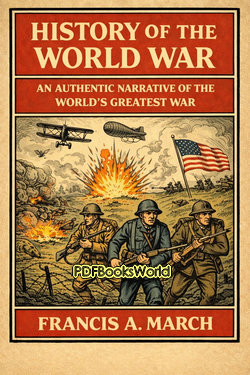
History of the World War - An Authentic Narrative of the World's Greatest War
by Francis A. March
A Sweeping Account of Global Conflict and Human Upheaval During World War I
Trenches stretching across Europe, massive artillery bombardments, naval battles, political collapse, and millions of soldiers caught in industrialized warfare define the enormous historical scope of History of the World War: An Authentic Narrative of the World's Greatest War. Written during the aftermath of World War I, the work attempts to explain one of the most devastating conflicts in modern history through military description, political analysis, and dramatic historical storytelling.
The book reflects a period when the world was still trying to understand the scale and consequences of a war that transformed international politics and human society forever.
A Conflict Unlike Earlier Wars
World War I introduced forms of warfare whose destructive power shocked contemporaries across the globe. Industrial technology turned battlefields into landscapes of unprecedented devastation.
The book describes how:
- Machine guns and artillery reshaped combat
- Trench warfare created long stalemates and horrific conditions
- Aircraft, submarines, and tanks introduced new military technologies
- Entire civilian populations became affected by total war
The conflict expanded far beyond traditional battlefield boundaries.
The Global Scale of the War
Although much of the fighting occurred in Europe, the war involved nations and territories across multiple continents. Empires mobilized soldiers from colonies and allied nations, turning regional tensions into worldwide conflict.
The narrative follows major campaigns, political alliances, military leaders, and turning points that shaped the course of the war.
The immense geographic scale reinforces the sense that the entire international order was being tested.
The Human Cost Behind the Battles
Beyond military strategy and political events, the war produced extraordinary human suffering.
Soldiers endured:
- Mud-filled trenches and disease
- Constant artillery bombardment
- Psychological trauma and exhaustion
- Mass casualties on an industrial scale
Civilian populations also faced shortages, displacement, grief, and economic hardship.
The book attempts to capture both the heroism and tragedy associated with the conflict.
Politics, Nationalism, and Imperial Rivalry
The war emerged from complex international tensions involving alliances, imperial competition, nationalism, militarism, and political instability.
The narrative explores how diplomatic failures and escalating rivalries gradually pushed Europe toward catastrophe.
The collapse of long-standing empires after the war further transformed global politics and reshaped national boundaries.
The conflict permanently altered the twentieth century’s political landscape.
The Style of Early War Histories
Books written soon after World War I often combined historical reporting with dramatic patriotic language and emotional reflection.
History of the World War reflects that style through vivid battlefield descriptions, heroic narratives, and emphasis on the war’s historical significance.
The tone frequently balances documentation with emotional intensity.
Why History of the World War Still Holds Importance
History of the World War: An Authentic Narrative of the World's Greatest War remains valuable because World War I continues to shape modern history, politics, and collective memory. The conflict influenced international relations, technological warfare, national identity, and the social changes that followed throughout the twentieth century.
For readers interested in military history, global conflict, political transformation, and the origins of the modern world, the book offers a sweeping introduction to one of humanity’s most consequential wars.
Similar Genres
About the Author
Francis A. March was an American educator, historian, and author whose writings helped readers understand important events in history and literature. He believed that historical knowledge should be accessible to everyone and wrote in a clear, informative style that appealed to both students and general readers. Explore Francis A. March books to discover the author's life, literary career, and access notable works.