
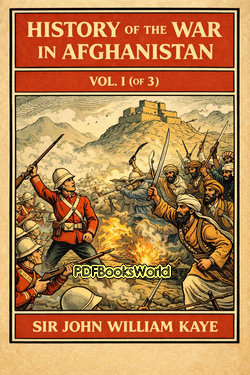
History of the War in Afghanistan, Vol. I (of 3)
by Sir John William Kaye
Empire, Strategy, and Disaster in Britain’s First Afghan Campaign
Mountain passes, political intrigue, tribal alliances, imperial rivalry, and military uncertainty dominate History of the War in Afghanistan, Vol. 1 by Sir John William Kaye. The book examines the origins and early stages of the First Anglo-Afghan War, one of the most controversial and disastrous military campaigns undertaken by the British Empire during the nineteenth century.
Blending military history with political analysis, Kaye explores how imperial ambition and diplomatic miscalculation drew Britain into a dangerous conflict far from its centers of power.
The “Great Game” Behind the War
The conflict cannot be understood without recognizing the larger geopolitical rivalry between Britain and Russia during the nineteenth century.
British authorities feared that expanding Russian influence in Central Asia might threaten India, then the empire’s most valuable possession.
Afghanistan therefore became strategically important as a buffer region between competing imperial powers.
This rivalry, often called the “Great Game,” shaped the political decisions leading to intervention.
Political Intrigue and Changing Alliances
Kaye carefully traces the complicated diplomatic relationships surrounding Afghanistan before the war.
The narrative involves:
- British political officials attempting to influence Afghan leadership
- Disputes over succession and regional power
- Shifting tribal loyalties and alliances
- Growing imperial anxiety about Russian expansion
These political tensions gradually escalated into military action.
The Challenge of Afghanistan’s Geography
One of the book’s recurring themes is the enormous difficulty of conducting military operations within Afghanistan’s harsh terrain.
Mountain ranges, narrow passes, severe weather, and long supply lines created constant logistical problems for invading armies.
Kaye emphasizes that geography itself became a powerful force shaping the outcome of the campaign.
The landscape repeatedly exposed the vulnerability of imperial military planning.
Early Signs of Disaster
Although the first volume focuses largely on the causes and opening phase of the war, tension steadily grows as British confidence begins colliding with political complexity and local resistance.
The campaign initially appeared manageable to many imperial officials, yet underlying instability remained visible beneath the surface.
Kaye suggests that misunderstanding Afghan society and overestimating imperial control contributed heavily to later catastrophe.
The sense of approaching danger shadows much of the narrative.
The Historical Style of Sir John William Kaye
Kaye writes with detail, seriousness, and strong narrative control. His approach combines military reporting with political interpretation and character study.
Descriptions of leaders, negotiations, and strategic decisions reveal deep interest in how individual judgment influences historical events.
The prose reflects nineteenth-century historical writing while maintaining dramatic momentum.
Why History of the War in Afghanistan Still Matters
History of the War in Afghanistan, Vol. 1 remains historically significant because Afghanistan has repeatedly challenged outside powers attempting intervention or control. Many themes explored in the book, including foreign influence, difficult terrain, political fragmentation, and imperial overconfidence, continued to shape later conflicts in the region.
For readers interested in military history, imperial politics, Central Asian studies, and nineteenth-century warfare, Sir John William Kaye’s work offers a detailed and revealing examination of one of Britain’s most troubled colonial campaigns.
Similar Genres
About the Author
Sir John William Kaye was a British soldier, historian, and author whose detailed studies of British India and nineteenth-century military campaigns established him as one of the leading historians of his time. After serving in the army and later working in government administration, he devoted himself to researching and writing history. Explore Sir John William Kaye books to discover the author's life, literary career, and access notable works.