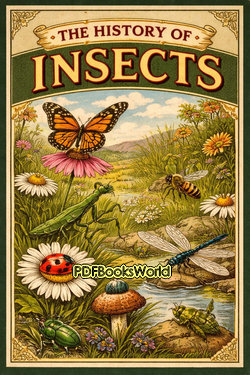
The History of Insects
by Anonymous
Small Creatures, Strange Worlds, and the Science of Curiosity
A beetle carrying armor stronger than its size suggests. A spider building geometric traps from silk. Ants constructing organized societies beneath the soil. The History of Insects transforms creatures often ignored or feared into subjects of fascination and careful study.
Written as an early educational natural history work for younger readers, the book introduces insects not as tiny background life, but as complex organisms with remarkable instincts, defenses, and survival strategies.
More Than a Simple Nature Book
What makes the work unusual is its mixture of science, moral reflection, and wonder. The author does not merely list insect species or physical descriptions.
Instead, readers are encouraged to think about:
How insects live, how they protect themselves, how they build homes, gather food, communicate, transform, and survive in environments humans rarely notice closely.
The result feels less like a textbook and more like an invitation to observe the hidden activity surrounding everyday life.
Insects and Creatures Explored in the Book
Bees organize communities with astonishing precision and labor.
Butterflies demonstrate dramatic transformation through the process of metamorphosis.
Ants reveal cooperation, construction, and social organization.
Spiders and Beetles display unusual survival mechanisms and defensive behavior.
How the Book Teaches Readers
Unlike modern scientific manuals filled with technical language, the explanations remain direct and conversational.
The educational method depends heavily on:
- observation of behavior,
- short descriptive passages,
- surprising natural facts,
- and comparisons that make insect life easier to imagine.
This approach makes complicated natural processes feel approachable even for younger readers.
The Hidden Drama of Insect Life
One of the book’s most interesting qualities is the realization that intense activity exists constantly beneath ordinary human attention.
Within gardens, fields, tree bark, ponds, and underground spaces, insects are continuously:
building, hunting, escaping predators, gathering food, reproducing, migrating, and adapting to changing seasons.
The book quietly reveals nature as a world filled with invisible labor and survival.
An Early Window Into Natural Science
The work also reflects a historical period when curiosity about science and the natural world was becoming increasingly important in children’s education.
Readers were encouraged not simply to memorize facts, but to:
observe carefully, respect living creatures, and understand that even the smallest forms of life possess structure and purpose.
This educational philosophy gives the book historical as well as scientific value.
Why the Subject Still Fascinates Readers
Modern readers continue to enjoy books about insects because these creatures remain both familiar and mysterious.
They provoke curiosity through:
unusual anatomy, transformation, camouflage, instinctive behavior, complex societies, and survival methods unlike those of larger animals.
Even common insects often appear extraordinary when closely examined.
Readers Most Likely to Enjoy the Book
This work may especially interest readers drawn to:
natural history, insect life, early science education, observational nature writing, zoology, and classic educational literature for children.
Closing Perspective
The History of Insects invites readers into a miniature world filled with intelligence, adaptation, labor, and biological wonder.
By turning attention toward creatures many people overlook, the book reminds readers that nature’s most fascinating stories are not always the largest or loudest, but sometimes hidden beneath leaves, inside flowers, or quietly moving beneath the ground.