
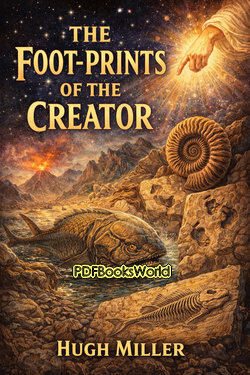
The Foot-prints of the Creator
by Hugh Miller
Science, Nature, and the Evidence of Ancient Life
The Foot-prints of the Creator by Hugh Miller is a landmark work of nineteenth-century natural history and geology. Written by one of Scotland's most respected self-taught scientists, the book explores fossils, prehistoric life, and the geological record while addressing some of the major scientific debates of its time. Miller combines careful observation with accessible prose, making complex geological subjects understandable to a broad audience.
The work is particularly notable for its discussion of fossil discoveries and what they reveal about the history of life on Earth. Through detailed descriptions and thoughtful analysis, Miller invites readers to consider the remarkable evidence preserved in rocks and ancient remains.
Hugh Miller's Scientific Journey
Hugh Miller began his career as a stone mason, a profession that gave him firsthand exposure to geological formations and fossils. His curiosity and dedication to learning eventually led him to become a respected writer and naturalist. Despite lacking formal scientific training, he earned recognition for the quality of his observations and his ability to communicate scientific ideas clearly.
This background gives the book an appealing blend of practical experience and intellectual inquiry.
The Fascination of Fossils
At the heart of the book is the study of fossils, which Miller viewed as valuable records of Earth's distant past. Fossils provide evidence of organisms that lived long before human history began, offering clues about ancient environments and the development of life.
Miller examines these discoveries with enthusiasm, demonstrating how fossil remains can reveal entire worlds that once existed but have since vanished.
Major Themes Found Throughout the Book
- Geology: Understanding Earth's structure and history.
- Paleontology: Investigating ancient forms of life through fossils.
- Observation: Learning from evidence found in nature.
- Scientific Inquiry: Exploring important questions about the natural world.
These themes make the book a significant contribution to popular science writing.
The Geological Record as a History Book
Miller viewed rock layers as pages in a vast historical record. Each formation preserved evidence of environmental conditions, biological communities, and geological events from different periods. By studying these layers, scientists could reconstruct aspects of Earth's past.
This perspective helped readers appreciate geology as a discipline capable of uncovering stories spanning millions of years.
Science and Nineteenth-Century Debate
The book was written during a period of intense discussion about the origins and development of life. New fossil discoveries were transforming scientific understanding, and researchers were debating how to interpret the evidence. Miller contributed to these discussions by presenting his observations and arguments in a thoughtful and accessible manner.
His work reflects both the excitement and the uncertainty that accompanied scientific progress during the era.
A Lasting Contribution to Popular Science
One of Miller's greatest strengths was his ability to make scientific subjects interesting to general readers. Rather than relying on technical language alone, he used vivid descriptions and engaging explanations to communicate complex ideas.
This approach helped broaden public interest in geology and natural history.
Why Readers Continue to Appreciate the Book
- Scientific Importance: A significant work in geology and fossil studies.
- Accessible Writing: Complex topics explained clearly.
- Historical Interest: Insight into nineteenth-century scientific thought.
- Natural Wonder: Exploration of Earth's ancient past.
Why The Foot-prints of the Creator Remains Worth Reading
The Foot-prints of the Creator is a fascinating exploration of fossils, geology, and the history of life on Earth. Through careful observation and engaging storytelling, Hugh Miller reveals the extraordinary evidence hidden within the geological record. The book remains valuable both as a scientific milestone and as an inspiring example of curiosity, dedication, and the pursuit of knowledge about the natural world.
Similar Genres
About the Author
Hugh Miller was a Scottish geologist, fossil collector, journalist, and author whose writings helped popularize geology during the nineteenth century. Largely self-educated, he rose from humble beginnings to become one of Britain's most respected scientific writers, admired for his ability to explain complex geological discoveries in clear and engaging language. Explore Hugh Miller books to discover the author's life, literary career, and access notable works.