
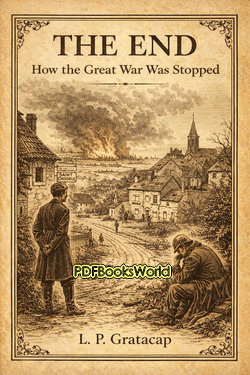
The End: How the Great War Was Stopped. A Novelistic Vagary
by L. P. Gratacap
An Unusual Speculative Novel Imagining the End of Global Conflict
The End: How the Great War Was Stopped. A Novelistic Vagary by L. P. Gratacap is an imaginative and politically reflective novel exploring the possibility of ending catastrophic warfare through unconventional means, visionary thinking, and speculative imagination. Written during or shortly after the era of the First World War, the work reflects the profound exhaustion, anxiety, and moral questioning produced by one of the most devastating conflicts in modern history.
The subtitle “A Novelistic Vagary” suggests that the author intentionally embraces imaginative freedom, presenting a story that may combine satire, fantasy, political speculation, scientific possibility, and philosophical reflection rather than strict realism. Gratacap uses fiction to ask a serious question: how might humanity bring an end to large-scale destruction once modern warfare threatens civilization itself?
The novel blends speculative fiction with political commentary and antiwar reflection.
Imagining an End to the Great War
The Great War: The conflict later known as World War I, whose unprecedented violence reshaped global politics, technology, and social consciousness.
The narrative likely introduces unusual inventions, visionary leaders, social transformations, scientific discoveries, or extraordinary events capable of forcing nations to abandon warfare and reconsider the future of civilization.
Rather than focusing solely on battlefield action, the story probably emphasizes diplomacy, ideology, fear of destruction, and humanity’s search for peace amid technological and political chaos.
The atmosphere combines intellectual curiosity, irony, and serious moral concern.
The Speculative Style of L. P. Gratacap
L. P. Gratacap writes with imaginative energy and philosophical ambition, using speculative storytelling to explore real political and ethical problems. His prose likely reflects the early twentieth-century tradition of visionary fiction where science, politics, and social criticism frequently intersected.
The language balances satire and reflection with dramatic speculative concepts.
Gratacap’s unconventional narrative approach gives the novel originality and intellectual intrigue.
Main Themes and Political Reflection
The novel explores themes of war, peace, technological power, political leadership, human survival, international conflict, moral responsibility, scientific progress, social transformation, and the fragility of civilization.
Through speculative scenarios and imaginative solutions, the work examines whether humanity can escape cycles of violence before destruction becomes irreversible.
The narrative may also reflect fears surrounding industrial warfare and the expanding destructive potential of modern technology.
Why the Novel Still Holds Interest
The End: How the Great War Was Stopped remains fascinating because speculative antiwar fiction offers insight into how writers responded emotionally and intellectually to the trauma of World War I.
Readers interested in early science fiction and political imagination often appreciate works that attempt to rethink global conflict through visionary or unconventional storytelling.
Its unusual blend of satire, speculation, and moral seriousness continues to make it distinctive.
The Lasting Importance of Antiwar Speculative Fiction
The unprecedented destruction of World War I inspired many writers to question nationalism, militarism, and technological warfare through fiction. Speculative novels became important vehicles for imagining alternative futures and warning against continued violence.
Such works often combined science, philosophy, and political criticism to explore humanity’s uncertain future within an increasingly mechanized world.
The continuing interest in peace studies, dystopian fiction, and war literature helps preserve appreciation for works like this.
Final Thoughts
The End: How the Great War Was Stopped. A Novelistic Vagary by L. P. Gratacap is a thought-provoking speculative novel exploring the possibility of ending global warfare through imagination, political reflection, and visionary storytelling. Through unconventional ideas and moral questioning, Gratacap creates a work that reflects both the fears and hopes of a world transformed by modern conflict.
For readers interested in speculative fiction, antiwar literature, political fantasy, and early twentieth-century social thought, this work remains both intellectually intriguing and historically revealing.
Similar Genres
About the Author
L. P. Gratacap was an American geologist, museum curator, scientist, and author whose interests extended far beyond the natural sciences. While he earned professional recognition for his work in geology and mineralogy, he also wrote imaginative fiction that explored the future of society, science, and international relations. Explore L. P. Gratacap books to discover the author's life, literary career, and access notable works.