
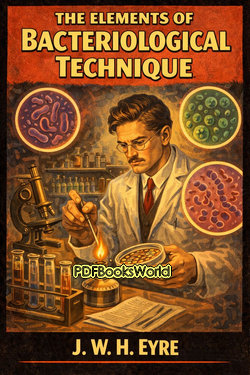
The Elements of Bacteriological Technique
by J. W. H. Eyre
Inside the Early Laboratory World of Bacteria and Scientific Discovery
The Elements of Bacteriological Technique by J. W. H. Eyre is a detailed scientific guide focused on the methods used in early bacteriology laboratories. Rather than discussing bacteria only in theory, the book teaches readers how scientists studied microorganisms through observation, experimentation, and careful laboratory practice.
Written for students and medical researchers, the work explains the tools, procedures, and techniques needed to examine bacteria safely and accurately. Although modern laboratory science has evolved over time, the book remains an interesting look into the foundations of microbiological research.
It also reflects a period when bacteriology was becoming one of the most important fields in medicine and public health.
Learning the Science Behind Laboratory Work
The book focuses heavily on practical instruction. Eyre explains how bacteriologists prepared samples, used microscopes, handled cultures, and identified microorganisms inside laboratory environments.
Instead of presenting science in a purely theoretical way, the author organizes the material around step-by-step procedures and technical accuracy. Readers gain insight into how scientists developed reliable methods for studying invisible organisms.
The text emphasizes patience, cleanliness, observation, and discipline, all of which were essential for successful laboratory work.
Main Areas Covered in the Book
Laboratory Equipment and Preparation
The book explains how scientists prepared workspaces and handled laboratory instruments to reduce contamination and improve accuracy.
Microscopic Examination
Readers learn how bacteria were observed and studied using microscopes and staining methods.
Culture Methods
The author discusses techniques used to grow microorganisms under controlled conditions for scientific analysis.
Sterilization and Safety
Special attention is given to cleanliness and sterilization, which were critical in preventing errors and limiting the spread of harmful bacteria.
Why Precision Matters in Bacteriology
One of the strongest ideas throughout the book is the importance of accuracy. Small mistakes inside a laboratory could completely change scientific results, leading to confusion or false conclusions.
Eyre repeatedly highlights the need for:
- Careful observation
- Clean laboratory conditions
- Accurate measurements
- Controlled experiments
- Consistent scientific methods
This focus on discipline reflects the growing professionalism of medical science during the period in which the book was written.
A Snapshot of Early Medical Research
Modern readers may find the book especially interesting because it captures the atmosphere of early twentieth-century scientific laboratories. At the time, bacteriology was rapidly changing medicine by helping researchers better understand infections and disease transmission.
The techniques described in the book helped shape future developments in:
- Medical diagnostics
- Public health research
- Vaccine development
- Hospital sanitation
- Microbiology education
The work therefore serves not only as a technical manual but also as a historical record of scientific progress.
The Writing Style Balances Detail With Instruction
The Elements of Bacteriological Technique is more technical than general science books written for casual readers. However, Eyre organizes the material clearly, making the information easier to follow for students and researchers.
The writing remains systematic and instructional, guiding readers through scientific procedures in a logical order. This structure reflects the careful mindset required in laboratory science itself.
Why the Book Still Holds Historical Value
Although modern microbiology now uses far more advanced technology, the principles discussed in this book still connect to the foundations of scientific research. Many modern laboratory practices grew from methods developed during the era Eyre describes.
The Elements of Bacteriological Technique remains valuable for readers interested in the history of medicine, microbiology, and scientific education. It offers a detailed glimpse into the disciplined world of early bacteriological research and the methods that helped transform modern healthcare.
Similar Genres
About the Author
J. W. H. Eyre, better known as John William Henry Eyre, was a British bacteriologist, physician, educator, and author whose work made significant contributions to laboratory medicine and microbiological education. Explore J. W. H. Eyre books to discover the author's life, literary career, and access notable works.