
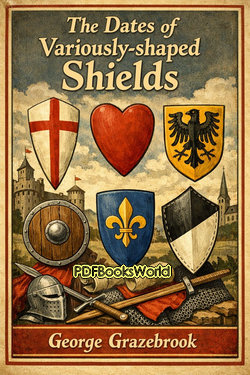
The Dates of Variously-shaped Shields
by George Grazebrook
How Medieval Shield Shapes Reveal the Hidden Timeline of Armor and Warfare
Long before modern military uniforms and standardized weapons, shields served as both protection and symbols of identity on the battlefield. Their shapes changed constantly across centuries, reflecting developments in warfare, armor, combat style, and artistic tradition. In The Dates of Variously-shaped Shields, George Grazebrook studies these evolving designs with remarkable historical precision.
Rather than treating shields as decorative museum objects alone, the book approaches them as historical evidence capable of revealing when warriors lived, how battles were fought, and how military technology changed over time.
Why Shield Shapes Matter in History
To modern readers, shields from different centuries may appear similar at first glance. Grazebrook demonstrates that even small differences in size, curve, angle, or decoration can help historians identify particular historical periods.
As armor improved and combat tactics evolved, shield designs adapted accordingly. A shield suitable for mounted Norman knights differed greatly from those used by later medieval soldiers or ceremonial figures.
Because many shields appear in tomb carvings, manuscripts, church monuments, and heraldic artwork, their forms provide valuable clues for dating historical objects and architecture.
Distinct Shield Styles Discussed
The book examines several important shield forms associated with different eras of European warfare.
- Kite-shaped shields connected with Norman cavalry and early medieval warfare
- Heater shields commonly associated with knights and heraldry
- Round and oval shields used in earlier combat traditions
- Decorative ceremonial shields appearing in later historical art
Each shape reflects practical military needs as well as artistic and cultural influences.
The Link Between Warfare and Design
One of the book’s most interesting ideas is that shield design changed alongside broader developments in military history.
As weapons became stronger and armor more advanced, shields often became smaller or differently shaped. Improvements in horseback combat, sword technique, and battlefield organization also influenced defensive equipment.
The study therefore becomes more than a discussion of objects. It turns into a deeper examination of how medieval warfare evolved over centuries.
A Resource for Historians and Collectors
Grazebrook’s research proved especially useful for historians, archaeologists, antiquarians, and collectors attempting to identify or date historical artifacts.
Church monuments, coats of arms, seals, manuscripts, and sculptures often include shield imagery. By studying their shapes carefully, researchers can estimate the historical period in which the artwork or object was created.
This careful attention to detail reflects the growing nineteenth-century interest in archaeology and historical classification.
The Writing Style of George Grazebrook
The book is written in a scholarly yet focused style emphasizing historical observation and visual analysis. Grazebrook approaches his subject systematically, examining evidence from monuments, heraldry, and historical illustration.
Although specialized, the work remains fascinating because it reveals how even small visual details can unlock broader historical understanding.
The combination of military history, art history, and archaeological investigation gives the study lasting value.
Why The Dates of Variously-shaped Shields Still Interests Readers
The Dates of Variously-shaped Shields continues to attract readers interested in medieval history, heraldry, armor, and historical research methods. The book demonstrates how objects often overlooked today can provide important insight into warfare, culture, and historical chronology.
For readers fascinated by knights, medieval combat, archaeology, and historical symbolism, George Grazebrook’s study offers a surprisingly detailed exploration of the defensive designs that once appeared across Europe’s battlefields and monuments.
Similar Genres
About the Author
George Grazebrook was an English antiquarian, historian, and author whose work focused on heraldry, genealogy, and medieval history. He devoted much of his career to studying historical records, family lineages, coats of arms, and the symbols that appeared in medieval art and architecture. Grazebrook believed that even small historical details could reveal important information about the past. Explore George Grazebrook books to discover the author's life, literary career, and access notable works.