
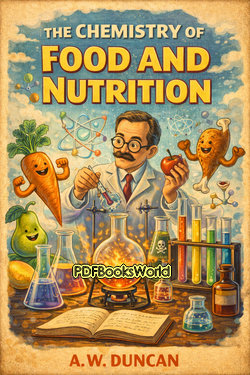
The Chemistry of Food and Nutrition
by A. W. Duncan
Nutrition, Digestion, and the Chemical Foundations of Human Health
The Chemistry of Food and Nutrition by A. W. Duncan is a scientific and educational work exploring the chemical composition of food and its importance to human health, energy, growth, and bodily function. Written during a period of expanding interest in nutrition science, the book explains how chemistry helps reveal the processes through which food sustains life and supports physical wellbeing.
Duncan presents nutrition as both a biological and chemical subject, emphasizing that understanding food scientifically allows humanity to make better decisions concerning diet, health, and everyday living.
The Chemical Nature of Food
The book examines the major nutritional components found in food, including proteins, carbohydrates, fats, minerals, water, and other substances necessary for bodily function.
Duncan explains how digestion transforms food into usable energy and materials for growth, repair, and maintenance within the human body.
Rather than treating eating merely as habit or tradition, the work demonstrates how scientific analysis can explain the nutritional value and physiological effects of different foods.
The volume also reflects the growing importance of chemistry and physiology in medicine, public health, and domestic science during the late nineteenth and early twentieth centuries.
Its tone combines scientific instruction with practical educational purpose.
Nutrition and Everyday Health
A central idea throughout the book is that proper nutrition strongly influences health, physical efficiency, and resistance to disease.
Duncan repeatedly emphasizes moderation, balanced diet, and understanding the nutritional properties of food rather than relying upon custom or misconception alone.
The work also explores how scientific knowledge of digestion and metabolism can improve daily life and public wellbeing.
This practical focus helped nutrition science become increasingly important within schools, medicine, and household education.
Scientific Topics Explored Throughout the Book
- Proteins, Fats, and Carbohydrates: Duncan explains the major nutrients required for energy and bodily function.
- Digestion and Metabolism: The book explores how the body processes food chemically and physiologically.
- Food Composition and Nutritional Value: Scientific analysis reveals the properties and usefulness of different foods.
- Chemistry and Human Health: Nutrition is connected to physical wellbeing, strength, and disease prevention.
- Scientific Approaches to Diet: The work encourages informed and rational understanding of eating habits.
The book reflects the growing scientific interest in nutrition during the early development of modern dietary science.
The Relationship Between Chemistry and Life
One of the work’s strongest ideas is that the human body operates according to chemical processes that can be studied and understood scientifically.
Duncan repeatedly demonstrates how food functions not simply as nourishment in a general sense, but as a complex combination of substances interacting with bodily systems.
The book also reveals how advances in chemistry transformed understanding of digestion, energy production, and physiological health.
This connection between chemistry and biology gives the work lasting educational significance.
A. W. Duncan’s Educational Scientific Style
The Chemistry of Food and Nutrition demonstrates A. W. Duncan’s ability to explain scientific principles in a clear, organized, and accessible manner suitable for students and general readers.
The writing remains practical, informative, and strongly focused upon applying scientific knowledge to everyday life and personal wellbeing.
Duncan consistently presents nutrition science as an important bridge between chemistry, medicine, and public health.
Why the Book Still Holds Historical and Educational Interest
Modern readers continue finding The Chemistry of Food and Nutrition valuable because it reflects the early development of nutrition science before vitamins, molecular biology, and modern dietary research transformed the field.
The book also provides insight into how scientific understanding of food and digestion evolved during an important era in medical and chemical education.
Its emphasis on balanced diet, scientific reasoning, and the relationship between nutrition and health continues to connect with many principles of modern nutritional science today.
For readers interested in chemistry, nutrition, food science, physiology, public health, scientific education, and the history of medicine, this work remains historically revealing, educational, and intellectually engaging.
Similar Genres
About the Author
A. W. Duncan was a British physician, nutrition educator, and author who sought to explain the relationship between chemistry, food, and human health in a practical and accessible way. His writings reflected a growing scientific interest in nutrition during the early twentieth century, when researchers were beginning to understand the chemical composition of foods and their effects on the body. Explore A. W. Duncan books to discover the author's life, literary career, and access notable works.