
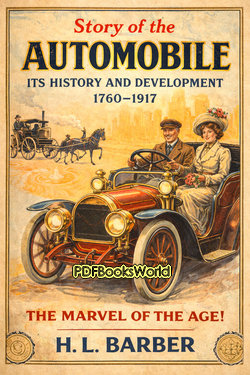
Story of the automobile: Its history and development from 1760 to 1917
by H. L. Barber
A Comprehensive History of the Automobile's Early Evolution
Story of the Automobile: Its History and Development from 1760 to 1917 by H. L. Barber is an informative account of one of the most transformative inventions in modern history. The book traces the gradual evolution of self-propelled vehicles from early mechanical experiments to the sophisticated automobiles of the early twentieth century. Through historical analysis and technical discussion, Barber illustrates how innovation, engineering, and persistence reshaped transportation and society.
The Dream of Self-Propelled Travel
Long before the modern automobile appeared, inventors sought ways to create vehicles capable of moving without animal power. Early designs relied on steam, mechanical ingenuity, and experimental engineering. Although many of these attempts were impractical, they laid the groundwork for later developments.
The book begins by examining these pioneering efforts and the visionaries behind them.
Major Subjects Covered
- Early Vehicle Experiments: Mechanical and steam-powered transportation concepts.
- Engine Development: Advances that made practical automobiles possible.
- Automobile Manufacturers: Companies and inventors who shaped the industry.
- Technological Innovation: Improvements in design, safety, and performance.
- Social Change: The impact of automobiles on everyday life.
From Steam to Internal Combustion
A major theme of the book is the transition from steam-powered vehicles to machines driven by internal combustion engines. This technological shift dramatically improved efficiency, reliability, and practicality, making widespread automobile use possible.
Barber explains how these engineering advances transformed transportation.
The Inventors and Innovators
The history of the automobile is filled with inventors, engineers, and entrepreneurs who contributed new ideas and solutions. The book highlights the efforts of individuals who refined engines, improved vehicle design, and expanded manufacturing capabilities.
Their work helped turn experimental machines into practical means of transportation.
The Rise of the Automobile Industry
As automobiles became more reliable and affordable, manufacturers developed new production methods to meet growing demand. The industry expanded rapidly during the late nineteenth and early twentieth centuries, creating economic opportunities and encouraging technological competition.
The automobile soon became a symbol of progress and modernity.
Changing Daily Life
Barber explores how automobiles altered patterns of travel, commerce, and communication. Communities became more connected, travel times decreased, and personal mobility increased dramatically. The effects extended far beyond transportation itself.
The automobile reshaped both cities and rural regions.
A Snapshot of the Industry in 1917
By ending in 1917, the book captures a pivotal moment in automotive history. At that time, the automobile had already become a significant force in society, yet many future innovations were still to come. Readers gain insight into how the industry appeared during its formative years.
The work serves as a valuable historical record of an evolving technology.
Why the Book Remains Valuable
Students of transportation history, engineering, industrial development, and economic change continue to find the book useful. It documents the achievements and challenges that accompanied the rise of one of the world's most influential technologies.
The historical perspective helps readers appreciate the scale of automotive progress.
A Fascinating Chronicle of Technological Progress
Story of the Automobile: Its History and Development from 1760 to 1917 offers a detailed examination of the invention and growth of the automobile. Through its exploration of inventors, engineering breakthroughs, and social transformation, H. L. Barber presents a compelling account of how a revolutionary idea became a defining feature of modern life. The book remains an important resource for understanding the origins of automotive transportation and its lasting impact on society.
Similar Genres
About the Author
H. L. Barber was an American author, historian, and technical writer whose work focused on documenting the rapid evolution of transportation during the early twentieth century. Writing at a time when the automobile was transforming everyday life, Barber sought to preserve the history of mechanical innovation and the pioneers who shaped modern road travel. Explore H. L. Barber books to discover the author's life, literary career, and access notable works.