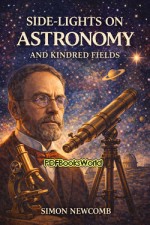
Simon Newcomb
Simon Newcomb was a Canadian-American astronomer, mathematician, economist, and author whose remarkable career made him one of the most respected scientific minds of his generation. His research helped improve the precision of astronomical calculations, planetary observations, and celestial mechanics at a time when astronomy was rapidly advancing. Beyond his technical achievements, Newcomb possessed a rare ability to explain scientific ideas in language that educated and inspired general readers. Through his books, lectures, and public writings, he encouraged people to appreciate not only the discoveries of astronomy but also the broader role of science in understanding the universe.
Precision That Changed Astronomy
Newcomb devoted decades to refining astronomical observations and mathematical calculations that were essential for navigation, timekeeping, and the study of planetary motion. His work produced more accurate astronomical tables and improved the methods used by observatories around the world. Because of his dedication to precision, his research became an important foundation for later developments in celestial mechanics and astrophysics.
His interests extended well beyond astronomy alone. Newcomb also contributed to mathematics, economics, and scientific philosophy, demonstrating an extraordinary ability to connect different branches of knowledge. His broad intellectual curiosity made him one of the leading scientific scholars of his era.
Making Complex Science Readable
Although Newcomb carried out highly technical research, he believed that science should be shared with everyone. He wrote numerous books and essays for general readers, explaining astronomy, mathematics, and scientific reasoning in a clear and engaging manner. His accessible style encouraged people without formal scientific training to appreciate the discoveries that were reshaping humanity's understanding of the universe.
Among his widely read publications is Side-lights on Astronomy and Kindred Fields, a collection of essays that explores astronomy alongside related scientific subjects. The work reflects his talent for presenting thoughtful discussions that combine scientific knowledge with historical perspective and philosophical reflection.
A Scholar Across Many Disciplines
Newcomb's influence reached far beyond observatories and universities. He served in leading scientific organizations, advised governments on technical matters, and published research that earned international recognition. His work demonstrated how careful observation, logical thinking, and mathematical analysis could be applied to solve problems across many fields. This broad contribution strengthened his reputation as one of the foremost scientific thinkers of his time.
Notable Works
- Side-lights on Astronomy and Kindred Fields – A collection of essays exploring astronomy and related scientific topics for general readers.
- Popular Astronomy – Introduces the principles and discoveries of astronomy in clear, non-technical language.
- The Stars: A Study of the Universe – Examines the nature, structure, and evolution of stars and the wider universe.
- Astronomy for Everybody – Presents astronomy in an accessible style for readers beginning their study of the subject.
- The Reminiscences of an Astronomer – Shares personal reflections on Newcomb's scientific career and the development of modern astronomy.
A Legacy That Continues to Illuminate Science
Simon Newcomb's achievements transformed both professional astronomy and public understanding of science. His commitment to accuracy, education, and intellectual curiosity helped establish higher standards for astronomical research while making scientific knowledge available to a wider audience. His writings continue to inspire readers who wish to explore the universe through careful observation, thoughtful inquiry, and a lifelong love of learning.
Readers visiting PDF Books World can explore the works of Simon Newcomb and discover engaging books that showcase his contributions to astronomy, mathematics, and the popular understanding of science.