
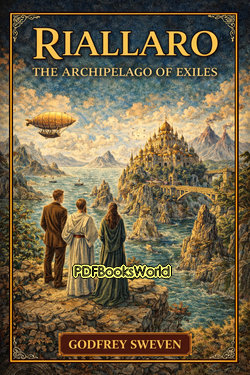
Riallaro: The Archipelago of Exiles
by Godfrey Sweven
A Thought-Provoking Utopian Adventure
Riallaro: The Archipelago of Exiles by Godfrey Sweven is a remarkable blend of adventure, philosophy, social criticism, and utopian fiction. Published in 1901, the novel imagines a mysterious island society that serves as a vehicle for exploring questions about government, morality, religion, gender relations, and the future of civilization. Written under the pseudonym Godfrey Sweven by John Macmillan Brown, the book belongs to the tradition of speculative works that use imaginary worlds to examine real social issues.
The story combines the excitement of exploration with deep philosophical discussion. As its characters encounter the unusual society of Riallaro, they are challenged to reconsider many assumptions about human nature and social organization.
A Mysterious Archipelago
The novel begins with the discovery of a stranger who has survived extraordinary circumstances and possesses knowledge of a remote and enigmatic archipelago known as Riallaro. As his story unfolds, readers are introduced to a remarkable society isolated from the rest of the world.
The islands serve as more than an exotic setting. They become a stage upon which the author explores alternative political and social arrangements.
Characters
- Somm: One of the men involved in rescuing and aiding the mysterious stranger washed ashore at the beginning of the novel.
- The Stranger: A central figure whose experiences and revelations introduce readers to the hidden world of Riallaro.
- The Inhabitants of Riallaro: Individuals whose customs, beliefs, and institutions embody the novel's social and philosophical ideas.
Adventure and Discovery
Although the novel is rich in ideas, it is also an adventure story. Exploration, survival, and encounters with unfamiliar cultures provide momentum and intrigue. The sense of mystery surrounding the archipelago encourages readers to continue uncovering its secrets.
The narrative balances action with intellectual inquiry, making it appealing to readers who enjoy both adventure and speculation.
Major Themes Found Throughout the Novel
- Utopian Thought: Imagining alternative forms of society.
- Exile: The experiences of those separated from ordinary civilization.
- Social Criticism: Questioning accepted customs and institutions.
- Human Progress: Exploring the possibilities and limitations of civilization.
These themes place the novel among the more ambitious works of early speculative fiction.
A Society Under Examination
The inhabitants of Riallaro live according to principles that differ significantly from those of conventional Western societies. Through descriptions of their customs and institutions, the author invites readers to compare different approaches to governance, education, and social relationships.
Rather than providing simple answers, the novel encourages reflection and debate about how societies should be organized.
Philosophy Through Fiction
One of the book's distinguishing features is its use of fiction as a means of exploring philosophical questions. Discussions about ethics, freedom, equality, and progress are woven into the narrative rather than presented as abstract arguments.
This approach allows readers to engage with complex ideas through the experiences of the characters and the society they encounter.
A Forgotten Classic of Speculative Literature
While not as widely known as some other utopian novels, Riallaro: The Archipelago of Exiles has earned recognition for its originality and intellectual ambition. Critics often compare its satirical and speculative elements to earlier classics of imaginary voyages and social commentary.
The novel remains an interesting example of how fiction can be used to examine contemporary social and political concerns.
Why Readers Continue to Appreciate the Book
- Inventive Setting: A mysterious and imaginative island world.
- Philosophical Depth: Exploration of social and ethical questions.
- Adventure Elements: Mystery, discovery, and exploration.
- Historical Significance: An early work of utopian and speculative fiction.
Why Riallaro Remains Worth Reading
Riallaro: The Archipelago of Exiles is a fascinating combination of adventure and social philosophy. Through its depiction of an isolated island society, Godfrey Sweven examines enduring questions about civilization, freedom, and human progress. More than a century after its publication, the novel continues to reward readers interested in utopian fiction, speculative thought, and imaginative explorations of how society might be organized differently.
Similar Genres
About the Author
Godfrey Sweven was the pen name of an imaginative British writer whose speculative fiction explored philosophy, politics, religion, and the possibilities of ideal societies. Writing during the late nineteenth century, Sweven used fictional worlds to examine questions that extended far beyond ordinary adventure stories. Explore Godfrey Sweven books to discover the author's life, literary career, and access notable works.