
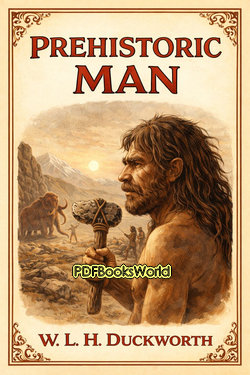
Prehistoric Man
by W. L. H. Duckworth
Exploring Early Human Life in Prehistoric Man
Prehistoric Man offers readers a fascinating look into the earliest stages of human existence long before written history, cities, or modern civilization appeared. The book examines how ancient humans lived, survived, created tools, and slowly developed the foundations of society.
Combining archaeology, anthropology, and historical interpretation, the work introduces readers to a world shaped by survival, discovery, and adaptation.
What the Book Explores
The book focuses on humanity’s distant past, covering the lives of early humans during prehistoric times. Since no written records existed during these ages, much of what researchers know comes from fossils, cave paintings, ancient tools, and burial sites.
The work discusses how prehistoric people:
Learned to hunt, discovered the use of fire, created simple tools, formed communities, and adapted to difficult environments over thousands of years.
Readers also gain insight into how scientists study ancient civilizations through physical evidence left behind.
Life in the Prehistoric World
Daily life during prehistoric times was centered on survival. Early humans faced dangerous animals, harsh weather, and limited resources.
Despite these challenges, prehistoric societies gradually developed important skills and innovations that changed human history forever.
These developments included:
- Stone tool creation
- Hunting techniques
- Use of fire for warmth and cooking
- Early forms of communication
- Primitive art and symbolic expression
The book explains how these advancements helped humans evolve socially and intellectually.
Major Ideas and Themes
Human Adaptation plays a central role throughout the book. Early humans constantly adjusted to changing climates, landscapes, and dangers in order to survive.
Innovation and Discovery also appear as important themes. Even simple inventions such as sharpened tools or controlled fire dramatically improved human life.
The book further highlights the importance of community and cooperation. Survival often depended on people working together for hunting, protection, and shared resources.
The Importance of Archaeology
One of the most interesting aspects of the book is its explanation of how archaeologists and historians uncover information about prehistoric societies.
Researchers study:
Ancient bones, fossils, tools, cave art, burial grounds, and environmental evidence to understand how early humans lived and evolved.
This scientific approach helps transform fragments of the past into a clearer picture of human origins.
Why Prehistoric History Still Matters
Although prehistoric humans lived thousands of years ago, their story remains deeply connected to modern life. The development of tools, language, cooperation, and social structures eventually shaped all later civilizations.
Understanding prehistoric life also helps readers appreciate:
- The long journey of human development
- The importance of innovation
- The relationship between humans and nature
- The origins of culture and society
The book reminds readers how much humanity has changed while also showing the basic survival instincts that remain universal.
Writing Style and Presentation
Prehistoric Man presents historical and scientific information in a clear and educational style. The writing focuses on explanation and evidence rather than dramatic storytelling.
The book combines factual discussion with descriptions of ancient life, making the subject easier for general readers to understand.
Who Might Enjoy This Book?
This work may especially interest readers who enjoy:
Ancient history, archaeology, anthropology, human evolution, early civilizations, and educational nonfiction about the human past.
Students and history enthusiasts may also find the book useful as an introduction to prehistoric studies.
Final Thoughts
Prehistoric Man provides an engaging exploration of humanity’s earliest history and the long path toward civilization. By examining survival, invention, and social development, the book helps readers understand how ancient humans shaped the foundations of the modern world.
For anyone curious about human origins and the distant past, this work offers an informative and thought-provoking introduction to prehistoric life.
Similar Genres
About the Author
W. L. H. Duckworth, or William Lawrence Henry Duckworth, was a British anthropologist, anatomist, and archaeologist whose research advanced the scientific study of human evolution and prehistoric societies. A respected scholar at the University of Cambridge, he devoted his career to examining ancient human remains, comparative anatomy, and the origins of humankind. Explore W. L. H. Duckworth books to discover the author's life, literary career, and access notable works.