
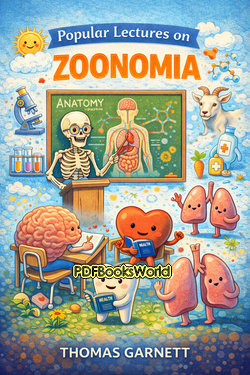
Popular Lectures on Zoonomia
by Thomas Garnett
Physiology, Health, and the Scientific Laws Governing Animal Life
Popular Lectures on Zoonomia by Thomas Garnett is an educational and scientific work presenting lectures on physiology, health, disease, sensation, and the principles governing living organisms. Inspired by the ideas of Erasmus Darwin’s Zoonomia, the book attempts to explain the functions of the human body and animal life through scientific observation, medical reasoning, and natural law.
Garnett presents physiology not merely as a medical subject for specialists, but as an area of knowledge that ordinary educated readers could understand and apply to health, behavior, and daily life.
The Scientific Study of Life and Bodily Function
The book explores major physiological systems including circulation, respiration, digestion, sensation, muscular movement, and nervous activity. Garnett discusses how the organs and bodily systems cooperate to sustain life and respond to environmental conditions.
He also examines the causes of disease, the effects of stimuli upon the body, and the relationship between physical health and nervous energy.
Rather than relying solely upon traditional medical authority, the work emphasizes observation, scientific reasoning, and the search for general laws governing organic life.
The volume reflects the intellectual climate of the late Enlightenment and early nineteenth century, when physiology, chemistry, and medicine were increasingly shaped by experimental science and natural philosophy.
Its tone combines scientific instruction with philosophical reflection and public education.
The Influence of Zoonomia and Enlightenment Science
A major theme throughout the book is the belief that living organisms operate according to discoverable natural principles. Garnett adapts and popularizes many physiological and medical ideas associated with Erasmus Darwin’s broader theories of organic life.
The work reflects growing interest in understanding sensation, movement, disease, and mental activity through physiology and nervous processes rather than purely metaphysical explanation.
Garnett also sought to make scientific lectures more accessible to wider audiences outside universities and medical institutions, helping spread public interest in natural science.
This effort to combine medicine, education, and public scientific culture gives the book lasting historical importance.
Scientific and Medical Topics Explored Throughout the Book
- Physiology and Organic Function: Garnett explains circulation, respiration, digestion, and muscular activity.
- Nerves, Sensation, and Perception: The book explores the connection between bodily systems and sensory experience.
- Health and Disease: Scientific reasoning is applied to illness, bodily imbalance, and physical wellbeing.
- The Laws of Animal Life: Organic processes are presented as governed by consistent natural principles.
- Popular Science and Public Education: Complex scientific ideas are adapted for general readers and lecture audiences.
The book reflects the growing movement toward scientific popularization during the early nineteenth century.
The Human Body as a System Governed by Natural Law
One of the work’s strongest ideas is that bodily processes and diseases can be understood scientifically through observation and analysis.
Garnett repeatedly demonstrates how respiration, circulation, sensation, and nervous activity interact within a coordinated living system.
The book also reveals the strong influence of Enlightenment optimism concerning humanity’s ability to understand nature through reason and experiment.
This scientific approach helped physiology emerge as a more organized and systematic field of study.
Thomas Garnett’s Educational Scientific Style
Popular Lectures on Zoonomia demonstrates Thomas Garnett’s ability to combine medical science, physiology, and public instruction into clear and engaging lectures suitable for educated audiences.
The writing remains explanatory, organized, and strongly focused upon making complex physiological ideas understandable through examples and careful reasoning.
Garnett consistently presents science as a practical and intellectual tool for understanding life, health, and the natural world.
Why the Book Still Holds Historical and Scientific Interest
Modern readers continue finding Popular Lectures on Zoonomia historically valuable because it reflects early nineteenth-century attempts to popularize physiology and medical science for broader audiences.
The book also provides insight into how the ideas of Erasmus Darwin influenced discussions of biology, medicine, nervous activity, and organic life before the rise of modern evolutionary theory and neuroscience.
Its combination of physiology, public lectures, and Enlightenment science remains historically important within the development of scientific education and popular medical writing.
For readers interested in physiology, medical history, Enlightenment science, early biology, public scientific education, and the history of medicine, this work remains historically revealing, intellectually ambitious, and scientifically engaging.
Similar Genres
About the Author
Thomas Garnett was an English physician, natural philosopher, chemist, and educator whose work reflected the broad scientific interests of the Enlightenment. He believed that knowledge should be shared beyond universities and made accessible to the general public through clear lectures and practical examples. Explore Thomas Garnett books to discover the author's life, literary career, and access notable works.