
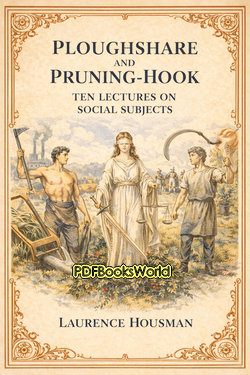
Ploughshare and Pruning-Hook: Ten Lectures on Social Subjects
by Laurence Housman
A Thoughtful Examination of Society and Human Progress
Ploughshare and Pruning-Hook: Ten Lectures on Social Subjects by Laurence Housman is a collection of lectures that explores a range of social, ethical, and cultural issues through the perspective of one of Britain's most engaged public intellectuals. Written during a period of significant social change, the work reflects Housman's commitment to reform, justice, and the improvement of society through thoughtful discussion and informed action.
The title alludes to the famous biblical image of transforming swords into ploughshares and spears into pruning-hooks, symbolizing the replacement of conflict with constructive effort. This ideal of progress through cooperation and understanding serves as a guiding principle throughout the lectures.
The collection offers readers an opportunity to engage with important questions concerning citizenship, social responsibility, and the future of society.
Laurence Housman and Social Reform
Laurence Housman was a writer, dramatist, illustrator, and social activist whose work frequently addressed issues of justice and public welfare. Throughout his career, he participated in debates concerning political reform, civil rights, and social equality.
His lectures reveal a belief that thoughtful individuals have a responsibility to engage with the problems of their time. Rather than accepting existing conditions without question, Housman encourages readers and listeners to consider how society might be improved through reason, compassion, and collective effort.
This commitment to reform shapes the tone and purpose of the collection.
The Meaning of the Title
The imagery of the ploughshare and pruning-hook emphasizes productive labor, cultivation, and peaceful development. Housman uses this symbolism to suggest that societies flourish when energy is directed toward constructive goals rather than conflict and division.
The lectures repeatedly return to the idea that meaningful progress requires both practical action and moral reflection. Social improvement is presented not as an abstract ideal but as a task demanding commitment and cooperation.
This theme unifies the diverse subjects addressed throughout the volume.
Exploring Social Questions
The ten lectures examine issues that were widely discussed during the early twentieth century and that continue to resonate with modern readers.
- The responsibilities of citizenship.
- Social justice and public welfare.
- Ethical conduct in public life.
- The relationship between individuals and society.
Rather than offering simple solutions, Housman encourages thoughtful consideration of the principles underlying social problems and proposed reforms.
The Power of Public Discussion
A central belief expressed throughout the collection is that open discussion plays an essential role in social progress. Housman views public debate, education, and intellectual engagement as important tools for addressing societal challenges.
By encouraging readers to examine issues critically, he hopes to foster greater awareness and participation in civic life. The lectures demonstrate confidence in the ability of informed citizens to contribute positively to their communities.
This emphasis on dialogue gives the work a distinctly democratic spirit.
Ethics and Social Responsibility
Many of the lectures explore the moral dimensions of social life. Housman argues that public institutions and individual actions should be guided by principles of fairness, compassion, and responsibility.
He suggests that social problems cannot be understood solely in economic or political terms. Ethical considerations are equally important because they influence how individuals relate to one another and how societies define their priorities.
This moral perspective adds depth to the collection's analysis of public issues.
A Reflection of Its Historical Era
The lectures emerged during a time of rapid political, industrial, and social transformation. Questions concerning democracy, labor, education, and equality were increasingly prominent in public discourse.
As a result, the collection serves as a valuable historical document, revealing how thoughtful observers responded to the challenges and opportunities of their age. While some specific concerns reflect the circumstances of Housman's era, many of the broader themes remain relevant today.
The work provides insight into both historical debates and enduring social questions.
Final Thoughts
Ploughshare and Pruning-Hook: Ten Lectures on Social Subjects by Laurence Housman is a thoughtful and engaging exploration of social responsibility, ethical citizenship, and the pursuit of constructive change. Through a series of reflective lectures, Housman encourages readers to consider how societies can be improved through cooperation, justice, and informed public engagement.
For readers interested in social history, political thought, ethics, and reform movements, this collection offers valuable insights into the challenges of building a more humane and responsible society.
Similar Genres
About the Author
Laurence Housman was an English playwright, novelist, illustrator, poet, and social reformer whose diverse talents made him a distinctive voice in early twentieth-century British literature. Equally committed to artistic expression and public service, Housman wrote fiction, drama, essays, and poetry while actively supporting causes such as women's suffrage, social justice, and civil liberties. Explore Laurence Housman books to discover the author's life, literary career, and access notable works.