
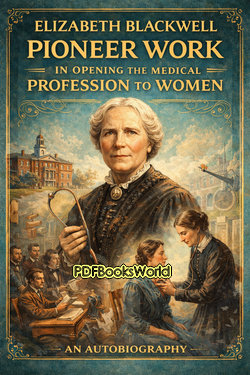
Pioneer Work in Opening the Medical Profession to Women
by Elizabeth Blackwell
Breaking Barriers: Elizabeth Blackwell’s Account of a Historic Struggle
Pioneer Work in Opening the Medical Profession to Women by Elizabeth Blackwell is a remarkable autobiographical and historical work that chronicles one of the most significant social transformations of the nineteenth century. As the first woman to earn a medical degree in the United States, Blackwell played a pioneering role in challenging the barriers that prevented women from entering the medical profession.
More than a personal memoir, the book documents a broader movement for educational opportunity, professional equality, and social reform. Through her experiences, Blackwell offers readers a firsthand view of the obstacles faced by women seeking careers in fields traditionally reserved for men.
The work stands as both a historical record and an inspiring testament to perseverance, conviction, and the pursuit of justice.
A Revolutionary Achievement
When Elizabeth Blackwell decided to study medicine, the idea of a female physician was widely viewed as impractical or even unacceptable. Medical schools routinely excluded women, and many members of society doubted that women possessed either the ability or the right to pursue professional medical training.
Despite these attitudes, Blackwell persisted. Her acceptance into medical school and subsequent graduation marked a turning point in educational history. What had once seemed impossible became a precedent that encouraged other women to follow similar paths.
Her achievement was important not only because of personal success but because it challenged assumptions about women's capabilities and roles in society.
The Challenges Along the Way
Blackwell's journey was far from easy. Throughout the book, she describes the resistance encountered at nearly every stage of her career.
Among the difficulties she faced were:
- Limited access to medical education.
- Social prejudice against women physicians.
- Professional skepticism and exclusion.
- Institutional barriers within hospitals and training programs.
Rather than discouraging her, these obstacles strengthened her determination to create opportunities for future generations.
Beyond Personal Success
One of the most compelling aspects of the book is Blackwell's focus on broader reform. She did not view her accomplishments as individual victories alone. Instead, she regarded them as part of a larger effort to expand educational and professional opportunities for women.
Her work contributed to the establishment of institutions and initiatives that helped women gain access to medical training and healthcare careers. By opening doors for others, she transformed a personal struggle into a lasting social achievement.
The narrative illustrates how individual determination can influence institutional change.
The Ideas at the Heart of the Book
Several themes emerge throughout Blackwell's account.
Equality of Opportunity: The belief that professional advancement should depend upon ability and dedication rather than gender.
Education as Empowerment: Access to knowledge as a pathway toward independence and social progress.
Public Service: Medicine as a profession devoted to improving human welfare.
Perseverance: The importance of persistence when confronting entrenched opposition.
These themes give the work significance beyond its historical setting.
Elizabeth Blackwell’s Writing and Perspective
Blackwell writes with clarity, intelligence, and moral conviction. Her tone is reflective rather than self-congratulatory, emphasizing the lessons learned from experience and the broader implications of social reform.
The book combines personal narrative with historical commentary, allowing readers to understand both the emotional realities of her journey and the larger societal forces she confronted.
Her perspective provides valuable insight into the challenges facing women during a period of significant social change.
Why the Work Still Matters
Pioneer Work in Opening the Medical Profession to Women remains important because it documents a transformative chapter in the history of education and professional opportunity. The struggles described by Blackwell helped pave the way for future generations of women in medicine and countless other professions.
The book also serves as a reminder that many advances now taken for granted were achieved through persistence, courage, and sustained advocacy.
Modern readers can appreciate both its historical value and its enduring message about equality and determination.
Final Thoughts
Pioneer Work in Opening the Medical Profession to Women by Elizabeth Blackwell is an inspiring account of one woman's efforts to challenge barriers and expand opportunities within a traditionally exclusive profession. Through personal experience, historical insight, and unwavering commitment to reform, Blackwell documents a movement that reshaped the medical field and broadened possibilities for generations to come.
For readers interested in women's history, medicine, social reform, education, and biography, this work remains a powerful and influential contribution to the story of human progress.
Similar Genres
About the Author
Elizabeth Blackwell was a pioneering physician, educator, and social reformer who became the first woman to earn a medical degree in the United States. At a time when women were largely excluded from the medical profession, she challenged long-standing barriers through determination, academic excellence, and unwavering commitment to public service. Explore Elizabeth Blackwell books to discover the author's life, literary career, and access notable works.