
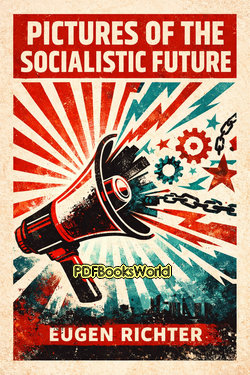
Pictures of the Socialistic Future
by Eugen Richter
A Pioneering Political Dystopia and Social Satire
Pictures of the Socialistic Future by Eugen Richter is a political satire and dystopian novel first published in 1891. Written decades before the rise of twentieth-century socialist states, the book imagines a future Germany in which a socialist revolution has succeeded and the government assumes control over economic and social life. Through a fictional diary narrative, Richter explores what he believed would be the practical consequences of implementing socialist doctrines on a national scale.
The novel is notable for presenting its story from the perspective of a supporter of the revolution. As the narrative progresses, the enthusiastic narrator gradually becomes disillusioned as shortages, restrictions, and state controls begin to affect everyday life. This structure allows Richter to combine political criticism with a dramatic personal story.
Today, the book is regarded as one of the earliest examples of political dystopian fiction and an important contribution to debates about socialism, individual liberty, and state power.
The Revolutionary Setting
The story begins after a successful socialist revolution has transformed Germany. The new government promises equality, prosperity, and social justice, assuring citizens that collective ownership and centralized planning will create a better society for all.
Initially, many citizens welcome the changes and believe they are participating in the creation of a more equitable future. However, as the system becomes established, practical difficulties begin to emerge. Economic disruptions, bureaucratic controls, and increasing restrictions on personal freedom gradually challenge the optimistic expectations that accompanied the revolution.
The Diary of a Believer
One of the novel's most distinctive features is its diary format. Rather than presenting events through an outside observer, Richter allows readers to follow the experiences of a devoted socialist supporter.
This narrative approach serves several purposes:
- It provides a personal perspective on political change.
- It reveals the gradual growth of disillusionment.
- It highlights the gap between ideals and outcomes.
- It allows satire to emerge through everyday experiences.
As conditions worsen, the narrator struggles to reconcile his faith in the system with the realities he encounters.
Economic Control and Social Consequences
A major focus of the novel is the impact of centralized economic planning. Richter imagines a society in which the state controls production, employment, and distribution of goods. The narrative argues that such control leads to shortages, inefficiency, and declining living standards rather than the prosperity promised by revolutionary leaders.
Through fictional examples, the novel explores how government management of economic activity affects ordinary families, workers, and professionals. These concerns reflect debates that were already prominent in late nineteenth-century European politics.
Liberty and State Power
Beyond economic issues, Richter devotes considerable attention to questions of individual freedom. The novel depicts increasing surveillance, restrictions on movement, and limitations on dissent as the government attempts to maintain control over society.
The story suggests that concentrated political power can threaten civil liberties regardless of the ideals used to justify it. This concern with the relationship between freedom and authority forms one of the book's central themes.
Eugen Richter's Political Perspective
Eugen Richter was a prominent German liberal politician, journalist, and critic of both state socialism and authoritarian government. Throughout his political career, he advocated free markets, civil liberties, and limited government intervention. His novel reflects these convictions and was intended as a warning against policies he believed would undermine individual freedom and economic prosperity.
Although the book clearly advances a political argument, its fictional format enabled Richter to present his ideas in a more vivid and accessible manner than traditional political essays.
An Early Dystopian Vision
Modern readers often view Pictures of the Socialistic Future as an early predecessor to later dystopian works that examine the dangers of excessive state power and ideological conformity. While written before the major political upheavals of the twentieth century, the novel anticipates themes that would become common in later political fiction.
Its enduring significance lies not only in its political message but also in its place within the history of speculative and dystopian literature. The work demonstrates how fiction can be used to explore competing visions of society and the future.
Final Thoughts
Pictures of the Socialistic Future by Eugen Richter is a provocative and historically significant dystopian novel that examines the consequences of a fictional socialist revolution through satire and political speculation. By following the experiences of an initially enthusiastic supporter, Richter explores themes of freedom, economic organization, government power, and ideological disillusionment.
For readers interested in political fiction, dystopian literature, intellectual history, and nineteenth-century debates about society and government, this novel offers a fascinating glimpse into one of the earliest literary attempts to imagine a radically transformed future.
Similar Genres
About the Author
Eugen Richter was a German politician, journalist, economist, and author who became one of the leading advocates of classical liberalism in nineteenth-century Germany. A strong supporter of constitutional government, individual liberty, free markets, and civil rights, Richter devoted much of his career to opposing authoritarianism and excessive state control. Explore Eugen Richter books to discover the author's life, literary career, and access notable works.