
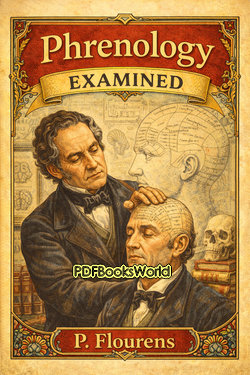
Phrenology Examined
by P. Flourens
A Scientific Critique of Nineteenth-Century Phrenology
Phrenology Examined by P. Flourens is a critical scientific work challenging the theories and claims of phrenology, the once-popular belief that mental abilities and personality traits could be identified through the shape of the skull. Written by the French physiologist Pierre Flourens, the book became an important response to phrenological ideas during the nineteenth century.
Flourens examines the scientific weaknesses of phrenology by using anatomical research, physiological experiments, and logical criticism. His work helped undermine the credibility of phrenology and contributed to the development of more accurate approaches to neuroscience and brain study.
The book reflects an important period in the history of science when debates about the brain, human behavior, and psychology were rapidly evolving.
Challenging the Claims of Phrenology
Phrenologists argued that specific mental faculties such as memory, courage, morality, and intelligence existed in separate regions of the brain and that the development of these regions affected the shape of the skull. According to the theory, personality could supposedly be “read” through bumps and contours of the head.
Flourens strongly questions these ideas. Drawing on experimental studies involving the nervous system and the brain, he argues that mental functions cannot be mapped so simply onto isolated skull regions in the way phrenologists claimed.
He also criticizes the lack of reliable scientific evidence supporting phrenological methods and conclusions.
The Analytical Style of Pierre Flourens
Pierre Flourens writes in a careful and logical style focused on scientific reasoning and experimental evidence. His arguments rely heavily on observation, physiology, and the scientific method rather than speculation or popular belief.
The tone remains serious and scholarly while still aiming to make the scientific discussion understandable for educated readers outside specialized medicine.
Flourens approaches the debate not simply as a philosophical disagreement, but as a question of scientific accuracy and intellectual responsibility.
Main Topics Explored in the Book
- The scientific claims of phrenology
- Brain function and nervous system research
- Experimental physiology and scientific method
- The relationship between science and pseudoscience
Why the Book Still Holds Historical Importance
Phrenology Examined remains historically important because it documents one of the major scientific debates of the nineteenth century concerning the human brain and behavior. Readers interested in neuroscience, psychology, and the history of science often study the book as an example of scientific criticism and intellectual progress.
The work also illustrates how experimental research gradually replaced speculative theories that lacked reliable evidence.
Its role in challenging pseudoscientific thinking continues to make it historically meaningful.
The Historical Rise and Decline of Phrenology
Phrenology became highly popular during the nineteenth century because it claimed to offer a simple scientific explanation for personality, intelligence, and morality. Public lectures, books, and demonstrations spread the theory widely across Europe and America.
However, advances in physiology and neuroscience eventually exposed major flaws in phrenological reasoning. Critics like Flourens helped shift scientific understanding toward more accurate methods of studying the brain.
The debate remains an important example of how science develops through evidence, experimentation, and critical examination.
Final Thoughts
Phrenology Examined by P. Flourens is a thoughtful and scientifically important critique of phrenological theory and its claims about the human mind. Through logical analysis and experimental evidence, Flourens challenged one of the nineteenth century’s most influential pseudoscientific movements.
For readers interested in neuroscience, psychology, scientific history, and the development of modern research methods, this work remains both educational and historically significant.
Similar Genres
About the Author
P. Flourens, better known as Pierre Flourens, was a French physiologist, physician, and academic whose pioneering experiments helped establish the foundations of modern neuroscience. Through careful scientific investigation, he challenged many widely accepted theories of his time and demonstrated the importance of experimental evidence in understanding the brain and nervous system. Explore P. Flourens books to discover the author's life, literary career, and access notable works.