
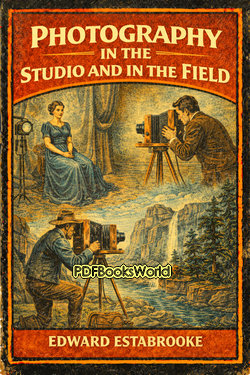
Photography in the Studio and in the Field
by Edward Estabrooke
Exploring the Art and Technique of Early Photography Indoors and Outdoors
Long before digital cameras and instant image editing, photography demanded patience, technical skill, careful lighting, chemical preparation, and artistic judgment. Photography in the Studio and in the Field by Edward Estabrooke examines the practical methods and creative challenges involved in photography during an era when the medium was still developing both as science and as art.
The book offers readers a fascinating look into the techniques photographers used to capture portraits, landscapes, architecture, and everyday scenes using early photographic equipment and processes.
The Studio as a Controlled Artistic Space
In studio photography, nearly every detail had to be carefully managed. Lighting, posing, background arrangement, exposure time, and chemical preparation all influenced the final image.
Estabrooke discusses how photographers created professional portraits through controlled conditions designed to produce clarity and visual balance.
The studio became both a technical workspace and a place of artistic composition.
Photography Beyond the Studio Walls
Field photography introduced entirely different challenges. Outdoor photographers had to work with changing weather, shifting sunlight, difficult transportation, and fragile equipment.
Capturing landscapes or distant scenes required adaptability and preparation.
The book explores practical concerns such as:
- Natural lighting conditions
- Transporting photographic materials safely
- Exposure adjustments outdoors
- Working in unpredictable environments
Photography in nature demanded both technical knowledge and physical endurance.
The Science Behind Early Photography
The work also reflects the scientific side of nineteenth-century photography. Photographers needed understanding of chemistry, optics, lenses, plates, and developing processes to achieve successful results.
Errors in preparation or timing could easily ruin photographs.
The book demonstrates how photography once required far more manual expertise than modern automated technology demands today.
Art and science remained closely connected throughout the process.
Photography as Historical Documentation
Estabrooke’s work reminds readers that photography quickly became an important method of preserving visual history.
Photographs recorded:
- People and family portraits
- Cities and architecture
- Natural landscapes
- Scientific observations and historical events
The expanding use of photography transformed how societies documented memory and reality itself.
The Artistic Eye of the Photographer
Although technical instruction plays a major role, the book also recognizes photography as a creative art form.
Composition, perspective, lighting, and emotional atmosphere all influence the power of an image.
Successful photographers needed not only equipment and chemicals, but also aesthetic judgment and patience.
The camera became a tool for artistic interpretation as well as mechanical recording.
Why Photography in the Studio and in the Field Still Fascinates Readers
Photography in the Studio and in the Field remains valuable because it reveals the craftsmanship and experimentation behind early photography. Modern digital photography often hides the technical complexity that earlier photographers confronted daily.
For readers interested in photographic history, visual culture, nineteenth-century technology, artistic technique, and the evolution of image-making, Edward Estabrooke’s work offers a detailed and engaging glimpse into the foundations of photography as both science and art.
Similar Genres
About the Author
Edward Estabrooke was an American photographer, educator, and author who helped promote the art and science of photography during the nineteenth century. At a time when photography was rapidly developing into both a practical profession and a creative art, Estabrooke shared his knowledge through clear and informative writing. Explore Edward Estabrooke books to discover the author's life, literary career, and access notable works.