
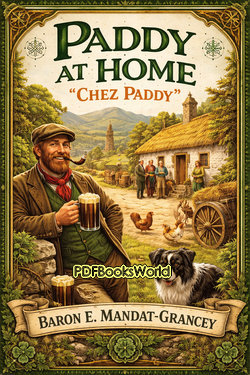
Paddy at Home
by E. De Mandat-Grancey
An Outsider’s View of Nineteenth-Century Ireland
Paddy at Home by E. De Mandat-Grancey is a travel and social observation work that offers readers a portrait of Ireland as seen through the eyes of a foreign visitor. Written during the late nineteenth century, the book explores Irish society, customs, landscapes, and daily life, combining travel narrative with commentary on the people and conditions the author encountered during his journey.
The title uses the familiar nickname "Paddy," a term commonly associated with the Irish in popular literature of the period. While modern readers may approach such terminology with caution, the book reflects the attitudes and conventions of its era. Through descriptions of towns, countryside, traditions, and social conditions, De Mandat-Grancey attempts to introduce Ireland to readers who may never have visited the island themselves.
The result is a work that functions as both a travel account and a historical snapshot of Irish life during a period of significant social and political change.
Traveling Through Ireland
One of the book's strengths lies in its descriptive treatment of the Irish landscape. The author records impressions of rolling countryside, coastal scenery, villages, and cities, often contrasting them with places familiar to continental European readers.
Rather than focusing solely on famous landmarks, he pays attention to everyday scenes and encounters, seeking to capture the character of the country as a whole. These observations help modern readers understand how Ireland appeared to visitors during the nineteenth century.
The travel narrative provides a sense of movement and discovery, carrying readers from one region to another while highlighting local distinctions and traditions.
The Irish People and Their Customs
A central focus of the book is the people themselves. De Mandat-Grancey comments on Irish manners, hospitality, humor, and community life, often attempting to explain cultural practices to foreign audiences.
Topics likely discussed include:
- Rural and village life.
- Social customs and traditions.
- Family and community relationships.
- Local attitudes and character.
These observations, while influenced by the author's personal perspective, provide valuable insight into how Irish society was perceived by contemporary travelers.
A Country in Transition
The Ireland described in Paddy at Home was experiencing important political, economic, and social developments. Questions of land ownership, national identity, and political reform occupied public attention, while many communities faced economic challenges and emigration.
Although the book is primarily a travel account, these larger issues often appear in the background of the author's observations. His descriptions reveal a country balancing long-standing traditions with the pressures of modernization and change.
This historical context adds depth to the narrative and increases its value as a document of its time.
The Author’s Perspective
E. De Mandat-Grancey approaches Ireland as an observer rather than a participant. His outsider perspective allows him to notice details that local residents might take for granted, but it also means his interpretations are shaped by his own cultural assumptions.
Modern readers can therefore appreciate the book both for what it reveals about Ireland and for what it reveals about nineteenth-century travel writing. Like many travel authors of the period, De Mandat-Grancey combines curiosity, admiration, and occasional criticism in his portrayal of the places he visits.
Why the Book Remains Interesting
Paddy at Home continues to attract readers because it preserves a contemporary account of Ireland during an important historical period. Travel narratives often capture details of everyday life that formal histories overlook, making them valuable sources for understanding the past.
The book also offers insight into how international visitors perceived Irish culture, society, and landscape at the close of the nineteenth century.
For historians and literary readers alike, such firsthand impressions provide a richer picture of the era.
Final Thoughts
Paddy at Home by E. De Mandat-Grancey is an engaging travel narrative that explores Ireland through observation, description, and cultural commentary. Combining scenic impressions with reflections on society and tradition, the book captures a country rich in character and history during a period of significant transformation.
For readers interested in travel literature, Irish history, cultural studies, and nineteenth-century society, this work remains an informative and thought-provoking account of Ireland as seen through foreign eyes.
Similar Genres
About the Author
E. De Mandat-Grancey was a French traveler, diplomat, and author whose writings introduced European readers to the customs, landscapes, and everyday life of countries beyond their own. His travel books combined careful observation with lively storytelling, offering readers a glimpse into the people, traditions, and social life of the places he visited. Explore E. De Mandat-Grancey books to discover the author's life, literary career, and access notable works.