
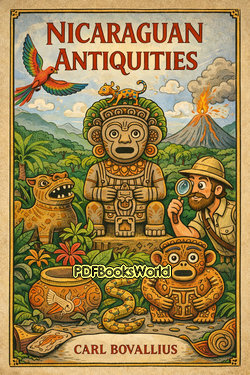
Nicaraguan Antiquities
by Carl Bovallius
Archaeology, Indigenous Culture, and the Ancient Civilizations of Nicaragua
Nicaraguan Antiquities by Carl Bovallius is an archaeological and ethnographic study examining the ancient cultures, artifacts, monuments, and indigenous history of Nicaragua. Written during the nineteenth century by the Swedish explorer and scientist Carl Bovallius, the book combines field observation, historical investigation, and cultural analysis while documenting the material remains of pre-Columbian civilizations in Central America.
Bovallius presents Nicaragua not merely as a modern nation, but as a region containing deep historical layers shaped by ancient peoples whose artistic traditions, religious beliefs, and social structures survived through artifacts and archaeological remains.
Exploring the Ancient Past of Nicaragua
The book describes Bovallius’s travels and investigations throughout Nicaragua, where he examined burial sites, stone sculptures, pottery, carvings, weapons, ornaments, and ceremonial objects connected to indigenous societies that existed long before European colonization.
Particular attention is given to the famous stone statues and carved figures discovered on islands within Lake Nicaragua, especially on Ometepe Island, where monumental sculptures suggested the existence of highly organized pre-Columbian cultures. Bovallius carefully records measurements, artistic details, and possible symbolic meanings associated with these artifacts.
The work also explores indigenous customs, legends, and surviving cultural traditions in an attempt to connect archaeological remains with the broader history of Central American peoples.
Rather than treating ancient societies as primitive curiosities, Bovallius emphasizes their artistic skill, craftsmanship, and cultural complexity.
Its tone combines scientific observation, travel narrative, and historical curiosity.
Archaeology and Cultural Memory
A major theme throughout the book is the importance of preserving and studying ancient artifacts as evidence of human creativity and civilization. Bovallius repeatedly argues that archaeological remains offer valuable insight into societies otherwise lost through conquest, time, and historical destruction.
The work also reflects nineteenth-century European fascination with archaeology, exploration, and the scientific study of non-European civilizations.
At the same time, the book attempts to challenge assumptions that indigenous American cultures lacked sophistication or historical depth.
This combination of scientific investigation and cultural appreciation gives the work enduring historical significance.
Historical and Archaeological Themes Explored Throughout the Book
- Pre-Columbian Civilization: The book examines the ancient cultures of Nicaragua before European conquest.
- Stone Sculpture and Archaeological Artifacts: Monuments, carvings, and ceremonial objects reveal artistic and religious traditions.
- Indigenous History and Identity: The work preserves evidence of Central American cultural heritage.
- Exploration and Scientific Observation: Fieldwork and documentation become essential tools of archaeology.
- Cultural Preservation: Ancient remains are presented as valuable historical records requiring protection and study.
The book stands as both archaeological report and travel narrative documenting early investigations into Central American antiquities.
The Importance of Ancient Civilizations
One of the work’s strongest ideas is that ancient cultures deserve careful study and respect regardless of whether written historical records survive.
Bovallius repeatedly demonstrates how sculpture, pottery, burial sites, and architecture preserve evidence of intellectual, artistic, and spiritual achievement.
The book also reveals the growing international interest in archaeology during the nineteenth century as scholars attempted to reconstruct the histories of indigenous civilizations across the Americas.
This sense of discovery gives the narrative lasting scholarly and cultural value.
Carl Bovallius’s Descriptive Scientific Style
Nicaraguan Antiquities demonstrates Carl Bovallius’s ability to combine detailed observation, careful documentation, and historical speculation into accessible archaeological writing.
The prose remains organized, descriptive, and strongly focused upon preserving accurate records of artifacts and cultural sites.
Bovallius consistently presents archaeology as a means of recovering forgotten human histories.
Why the Book Still Holds Historical Interest
Modern readers continue finding Nicaraguan Antiquities valuable because it preserves early archaeological observations of Central American cultures and monuments that remain historically important today.
The book also provides insight into nineteenth-century exploration, ethnography, and the development of archaeology as a scientific discipline.
Its themes of cultural preservation, indigenous history, artistic achievement, and historical discovery continue appealing to readers interested in ancient civilizations and anthropology.
For readers interested in archaeology, Nicaragua, indigenous cultures, Central American history, pre-Columbian civilizations, exploration literature, and historical anthropology, this work remains informative, historically important, and culturally fascinating.
Similar Genres
About the Author
Carl Bovallius was a Swedish naturalist, archaeologist, ethnographer, and explorer whose research contributed significantly to the study of Central American history and indigenous cultures. Driven by a passion for discovery, he traveled extensively through Central America, documenting archaeological sites, ancient artifacts, wildlife, and the traditions of local communities. Explore Carl Bovallius books to discover the author's life, literary career, and access notable works.