
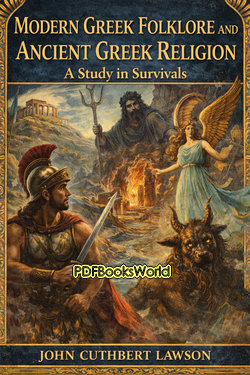
Modern Greek Folklore and Ancient Greek Religion: A Study in Survivals
by John Cuthbert Lawson
Exploring the Continuity Between Ancient Beliefs and Modern Traditions
Modern Greek Folklore and Ancient Greek Religion: A Study in Survivals by John Cuthbert Lawson is a landmark work of folklore, anthropology, and religious history. The book investigates the fascinating connections between the beliefs, customs, legends, and superstitions of modern Greece and the religious traditions of ancient Greek civilization. Through extensive research and firsthand observation, Lawson argues that many elements of ancient religion continued to survive in popular folklore long after the decline of classical paganism.
The study offers readers a unique perspective on cultural continuity, demonstrating how traditions can persist and evolve across centuries while adapting to changing historical and religious circumstances.
It remains an influential contribution to the study of folklore and comparative religion.
The Concept of Cultural Survivals
At the heart of Lawson's work is the idea of "survivals," the persistence of older beliefs and practices within later cultures. He suggests that customs often outlive the societies that originally created them, becoming integrated into new cultural and religious frameworks.
In Greece, where ancient civilization left an extraordinary legacy, Lawson finds numerous examples of traditions that appear to echo classical mythology and religious practice. These survivals provide valuable clues about the ways cultural memory is preserved over time.
This concept serves as the foundation for the book's investigations.
Folklore as a Window into the Past
Lawson treats folklore not merely as entertainment but as an important historical source. Folk tales, local legends, customs, and superstitions are examined as records of beliefs that may have deep historical roots.
Among the subjects explored are:
- Traditional stories about supernatural beings.
- Popular beliefs concerning spirits and the dead.
- Seasonal festivals and ceremonial customs.
- Rural practices connected to luck, protection, and healing.
These materials help reveal patterns that Lawson compares with ancient Greek religious traditions.
Ancient Gods and Folk Beliefs
One of the most intriguing aspects of the book is its examination of similarities between ancient deities and figures found in later folklore. Lawson investigates how characteristics once associated with gods, nymphs, and other mythological beings may have survived in transformed forms within popular traditions.
Rather than arguing for direct continuity in every case, he explores the possibility that ancient ideas influenced later stories and beliefs. This approach encourages readers to consider the long-term development of cultural traditions.
The comparisons provide some of the book's most memorable discussions.
John Cuthbert Lawson's Research Methods
John Cuthbert Lawson combined scholarly research with firsthand observation during his travels in Greece. He collected information from local communities while also drawing upon historical texts, classical literature, and earlier studies of folklore.
This combination of fieldwork and textual analysis allowed him to compare contemporary customs with ancient sources in a systematic manner. His interdisciplinary approach was innovative for its time and contributed significantly to the development of folklore studies.
The work reflects both scholarly rigor and genuine curiosity.
Religion, Myth, and Everyday Life
A recurring theme throughout the book is the close relationship between religious belief and daily experience. Lawson demonstrates how myths and spiritual ideas often influence ordinary customs, festivals, and social practices.
By examining these connections, he shows that religion is not confined to formal institutions but frequently shapes everyday life in subtle ways. Folk traditions become valuable evidence of how communities interpret the world around them.
This perspective broadens the scope of religious history.
An Influential Work of Folklore Scholarship
Since its publication, the book has attracted attention from scholars interested in anthropology, mythology, classical studies, and cultural history. While some interpretations have been debated and revised by later researchers, Lawson's work remains important for its extensive documentation and ambitious scope.
The study helped demonstrate the value of folklore as a tool for understanding both historical and contemporary cultures. Its influence can be seen in later investigations of myth, tradition, and cultural continuity.
The book continues to be widely consulted by students and researchers.
Final Thoughts
Modern Greek Folklore and Ancient Greek Religion: A Study in Survivals by John Cuthbert Lawson is a fascinating exploration of the connections between ancient mythology and living tradition. Through detailed analysis of folklore, customs, and popular beliefs, Lawson reveals how elements of the distant past may continue to shape cultural life centuries later.
For readers interested in folklore, mythology, anthropology, religious history, and Greek culture, this work offers a rich and thought-provoking examination of the enduring power of tradition.
Similar Genres
About the Author
John Cuthbert Lawson was a British classical scholar, folklorist, and author whose research bridged the worlds of ancient history, mythology, and living cultural traditions. Best known for his studies of Greek folklore, Lawson explored how customs, beliefs, and legends from ancient Greece continued to survive in modern Greek society. Explore John Cuthbert Lawson books to discover the author's life, literary career, and access notable works.