Michael Faraday
Michael Faraday was an English physicist, chemist, and experimental scientist whose discoveries transformed the understanding of electricity, magnetism, and chemistry. Despite receiving little formal education, he became one of the greatest scientific minds in history through curiosity, determination, and exceptional experimental skill. Faraday's pioneering work laid the foundation for modern electrical engineering and greatly influenced the development of physics and chemistry. Equally admired as a lecturer, he possessed a remarkable ability to explain complex scientific ideas in simple language, inspiring generations of students and researchers.
Revolutionizing Experimental Science
Faraday believed that careful observation and experimentation were the keys to scientific discovery. His investigations led to the discovery of electromagnetic induction, the principles behind electric motors and generators, and major advances in electrochemistry. He introduced important concepts such as the electric field and established the laws of electrolysis, providing a deeper understanding of chemical and electrical phenomena. His discoveries continue to influence modern technology, from power generation to communications.
Beyond his groundbreaking research, Faraday remained committed to sharing scientific knowledge. His experiments demonstrated that even the most complex natural phenomena could be understood through careful investigation and logical reasoning.
Making Chemistry Inspiring for Everyone
Faraday became renowned for his public lectures at the Royal Institution, where he captivated audiences with clear explanations and memorable scientific demonstrations. He believed that science should be accessible to people of all ages and backgrounds, especially young learners. His engaging teaching style transformed ordinary observations into fascinating lessons about the natural world, encouraging curiosity and critical thinking.
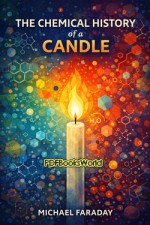
Among his most beloved works is The Chemical History of a Candle, based on a series of Christmas Lectures in which he used the simple burning candle to explain fundamental principles of chemistry and physics. The book remains a classic example of outstanding science communication.
Major Works
- The Chemical History of a Candle – Uses the familiar candle to explain the principles of chemistry, combustion, and scientific observation.
- Experimental Researches in Electricity – A landmark collection documenting Faraday's groundbreaking discoveries in electricity and magnetism.
- Experimental Researches in Chemistry and Physics – Presents influential investigations across chemistry and physical science.
- A Course of Six Lectures on the Various Forces of Matter – Explores the fundamental forces of nature through engaging public lectures.
- The Forces of Matter – Introduces readers to the physical principles governing the natural world through accessible scientific discussions.
A Legacy That Powers the Modern World
Michael Faraday's discoveries transformed both science and technology, influencing countless advances in electricity, chemistry, and physics. His commitment to experimentation, education, and public engagement made science more understandable while inspiring generations of researchers and innovators. Today, his work continues to shape modern scientific thought and remains a model of curiosity, precision, and lifelong learning.
Readers visiting PDF Books World can explore the works of Michael Faraday and discover timeless writings that celebrate the beauty of scientific discovery, the power of experimentation, and the enduring importance of chemistry and physics.