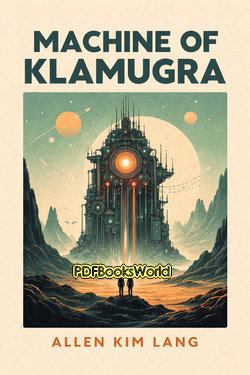
Machine of Klamugra
by Allen Kim Lang
Alien Justice, Martian Law, and the Dangerous Logic of a Perfect Machine
Machine of Klamugra by Allen Kim Lang is a science fiction novella blending interplanetary adventure, satire, courtroom tension, and philosophical reflection upon justice and technology. Originally published in Planet Stories in 1950, the story explores a highly advanced Martian legal system governed by a gigantic calculating machine designed to determine guilt and punishment with absolute precision.
Lang presents futuristic technology not simply as a source of progress and efficiency, but as a potentially dangerous force when mechanical logic replaces human judgment, flexibility, and moral understanding.
A Fatal Accident on Mars
The story follows Captain Jan Barnaby and Lieutenant Kim Teajun after their spaceship accidentally kills a Martian religious figure during landing procedures. Arrested and brought before the Judging Authority in the city of Klamugra, the two humans become trapped within an alien legal system unlike anything known on Earth.
At the center of this system stands the colossal Machine of Klamugra, an ancient computational device responsible for calculating legal outcomes according to rigid Martian law. The machine’s verdicts are treated as infallible, leaving little room for compassion, context, or human interpretation.
As Barnaby and Teajun attempt to survive the trial, they realize that defeating the system may require exploiting weaknesses within the machine’s supposedly perfect logic.
Rather than presenting alien civilization as unquestionably superior, the work satirizes excessive dependence upon mechanized authority and rigid bureaucracy.
The volume reflects classic mid-century science fiction fascination with computers, automation, and fears surrounding technological control over human affairs.
Its tone combines suspense, humor, speculative imagination, and social satire.
The Limits of Mechanical Justice
A major theme throughout the novella is the danger of allowing machines and rigid systems to replace human flexibility, wisdom, and moral reasoning.
Lang repeatedly explores how strict legal structures may become absurd or destructive when they cannot adapt to circumstance, accident, or individual complexity.
The work also reflects broader twentieth-century anxieties concerning bureaucracy, automated systems, and blind faith in technological perfection.
This satirical treatment gives the story intellectual depth beneath its adventurous surface.
Science Fiction and Philosophical Themes Explored Throughout the Story
- Mechanical Justice and Legal Automation: A gigantic machine determines guilt and punishment through inflexible calculation.
- Human Judgment Versus Technology: The story questions whether machines can truly understand morality or fairness.
- Alien Civilization and Martian Society: Mars is portrayed as technologically advanced yet socially rigid.
- Satire of Bureaucracy and Authority: Legal systems become vulnerable when procedure outweighs common sense.
- Survival Through Intelligence and Adaptation: The protagonists rely upon ingenuity rather than force alone.
The novella stands as an inventive example of socially aware pulp science fiction from the early atomic age.
The Fragility of “Perfect” Systems
One of the work’s strongest ideas is that systems claiming total precision and certainty often contain hidden weaknesses because they cannot fully account for unpredictable human behavior.
Lang repeatedly demonstrates how creativity, improvisation, and irrationality may defeat even highly advanced mechanical structures.
The story also reveals enduring science fiction fascination with the possibility that future societies might surrender too much authority to machines and automated decision-making.
This combination of humor, danger, and philosophical speculation gives the narrative lasting relevance.
Allen Kim Lang’s Satirical Science Fiction Style
Machine of Klamugra demonstrates Allen Kim Lang’s ability to combine fast-moving adventure, witty social commentary, and imaginative futuristic settings into engaging speculative fiction.
The writing remains energetic, accessible, and strongly focused upon balancing suspense with humorous critique of bureaucratic logic and technological overconfidence.
Lang consistently presents science fiction as a tool for questioning social systems as much as imagining future inventions.
Why the Story Still Holds Science Fiction Interest
Modern readers continue finding Machine of Klamugra fascinating because it anticipates ongoing debates concerning artificial intelligence, algorithmic decision-making, automated justice systems, and the role of human judgment within technologically advanced societies.
The novella also provides insight into early postwar science fiction and the growing cultural fascination with computers and automation during the 1950s.
Its themes of bureaucracy, technological authority, legal rigidity, and human ingenuity continue appealing to readers interested in thoughtful speculative fiction with satirical edge.
For readers interested in classic science fiction, Martian adventures, speculative law systems, AI and automation themes, pulp-era satire, and philosophical space fiction, this work remains imaginative, humorous, and intellectually engaging.
Similar Genres
About the Author
Allen Kim Lang was an American science fiction author whose imaginative stories embodied the excitement and creativity of the Golden Age of pulp science fiction. Writing during the mid-twentieth century, Lang crafted adventurous tales that transported readers to distant planets, introduced extraordinary technologies, and explored encounters with alien civilizations. Explore Allen Kim Lang books to discover the author's life, literary career, and access notable works, including An Eel by the Tail , and more.