
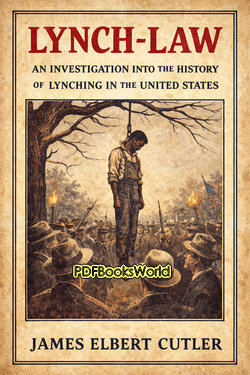
Lynch-law
by James Elbert Cutler
Examining Vigilante Justice in American History
Lynch-law by James Elbert Cutler is a significant historical and sociological study that investigates the practice of extrajudicial punishment in the United States. Written in the early twentieth century, the book seeks to understand why groups of people sometimes bypass formal legal systems and take justice into their own hands. Through careful research and analysis, Cutler examines the origins, causes, and consequences of lynching and vigilante actions, providing readers with a detailed look at a troubling aspect of American history.
Rather than focusing on individual incidents alone, the author explores broader social conditions and historical patterns. The result is a work that contributes to the understanding of law, social order, and the challenges faced by communities attempting to maintain justice.
Understanding the Meaning of Lynch Law
The term "lynch law" generally refers to punishment carried out without legal authority or judicial process. Throughout American history, such actions occurred in various regions and under different circumstances. Participants often justified these actions by claiming that formal institutions were ineffective or unavailable, while critics viewed them as violations of justice and the rule of law.
Cutler examines these competing perspectives, helping readers understand why such practices emerged and why they remained controversial. His study highlights the dangers that arise when legal procedures are ignored.
The Historical Background
The book places lynch law within a broader historical context. During periods of rapid expansion, social change, or weak governmental authority, some communities relied on informal systems of enforcement. Frontier settlements, isolated regions, and times of political instability often created conditions in which vigilante actions became more common.
By tracing these developments over time, Cutler shows how social and economic factors influenced attitudes toward law and punishment. His analysis helps readers understand the historical circumstances that contributed to these practices.
Major Topics Explored in the Study
- Origins of Vigilantism: The conditions that encouraged extralegal actions.
- Community Responses: How local populations reacted to crime and disorder.
- Legal Institutions: The role of courts and law enforcement in maintaining order.
- Social Consequences: The effects of bypassing established legal procedures.
These subjects provide a framework for understanding the broader issues surrounding justice and public authority.
The Importance of Due Process
A central theme throughout the book is the value of legal procedures and established institutions. Cutler emphasizes that justice requires fairness, evidence, and accountability. When individuals or groups act outside the law, mistakes and abuses become more likely, undermining public trust and social stability.
By examining historical examples, the author demonstrates why societies develop legal systems and why those systems play an essential role in protecting individual rights.
A Sociological Perspective
Beyond its historical content, the book offers insight into human behavior and group dynamics. Cutler explores how fear, anger, public opinion, and social pressures can influence collective actions. His work encourages readers to consider how communities respond to perceived threats and how emotions can shape decisions about justice.
This sociological approach makes the study valuable not only for historians but also for readers interested in understanding the relationship between society and law.
Key Themes Found Throughout the Book
- Justice and Fairness: The importance of lawful procedures.
- Social Order: Maintaining stability through effective institutions.
- Public Responsibility: The role of communities in supporting the rule of law.
- Historical Understanding: Learning from past practices and their consequences.
These themes remain relevant in discussions about legal systems, public policy, and civic responsibility.
Why Lynch-law Remains an Important Historical Work
Lynch-law continues to be studied because it provides valuable insight into a complex and difficult chapter of American history. Through its examination of vigilantism, legal institutions, and social behavior, James Elbert Cutler offers readers an opportunity to understand how communities have grappled with questions of justice and authority. The book remains a useful resource for those interested in history, sociology, law, and the ongoing importance of maintaining fair and accountable systems of justice.
Similar Genres
About the Author
James Elbert Cutler was an American sociologist, educator, and social researcher whose scholarly work examined crime, justice, race relations, and the development of legal institutions in the United States. Through careful historical investigation and systematic analysis, he sought to understand the social forces that shaped public attitudes toward law and order. Explore James Elbert Cutler books to discover the author's life, literary career, and access notable works.