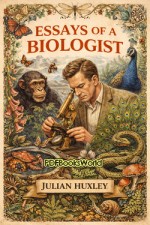
Julian Huxley
Julian Huxley was an English biologist, evolutionary thinker, educator, science writer, and one of the twentieth century's most influential popularizers of science. Renowned for his ability to explain complex biological concepts in clear and engaging language, Huxley devoted his career to promoting scientific understanding and encouraging the public to appreciate the natural world. His work extended beyond biology into conservation, education, philosophy, and international cooperation. As the first Director-General of UNESCO, he also championed the role of science and culture in building a more informed and peaceful world. His collection Essays of a Biologist reflects his remarkable ability to combine scientific knowledge with thoughtful reflections on nature, evolution, and humanity's place within the living world.
A Leader in Modern Biology
Julian Huxley was born into a distinguished family of scientists and writers. His grandfather was the celebrated biologist Thomas Henry Huxley, often called "Darwin's Bulldog" for his vigorous defense of evolutionary theory. Building upon this intellectual heritage, Julian developed a distinguished career in zoology and evolutionary biology. His research contributed to the modern evolutionary synthesis, which united Charles Darwin's theory of natural selection with the emerging science of genetics. Through both research and public education, he helped shape twentieth-century biological thought.
Beyond academic science, Huxley believed that scientific knowledge should be shared with everyone. He wrote books, delivered lectures, produced documentaries, and contributed articles that made biology understandable to readers without specialized training. His enthusiasm for learning inspired countless people to develop an interest in science and the natural environment.
Exploring Nature Through Essays
In Essays of a Biologist, Huxley examines a wide range of topics related to evolution, animal behavior, ecology, and human development. Rather than presenting technical research alone, he explains how biological discoveries influence our understanding of life and the natural world. His essays encourage readers to observe nature carefully, think critically, and appreciate the remarkable diversity of living organisms. Written in an accessible style, the collection demonstrates how science can deepen both knowledge and curiosity.
Notable Works
- Essays of a Biologist – A collection of thoughtful essays exploring biology, evolution, ecology, and humanity's relationship with nature.
- Religion Without Revelation – A philosophical work examining ethics, humanism, and the role of science in modern society.
- The Science of Life – A comprehensive introduction to biology, co-authored with H. G. Wells and G. P. Wells.
- Evolution: The Modern Synthesis – A landmark scientific work integrating evolutionary theory with modern genetics.
- Man in the Modern World – Essays discussing humanity, science, education, and social progress.
An Enduring Legacy
Julian Huxley is remembered as one of the foremost scientific communicators of the twentieth century. His research advanced evolutionary biology, while his books and essays inspired millions of readers to appreciate science as a vital part of human culture. His leadership in conservation, education, and international cooperation further expanded his influence beyond the laboratory. Today, his writings continue to encourage thoughtful exploration of the natural world and the scientific principles that govern it. Visitors to PDF Books World can explore Huxley's public domain works to discover insightful essays that celebrate biology, intellectual curiosity, and the enduring wonder of life on Earth.