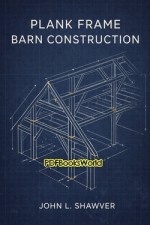
John L. Shawver
John L. Shawver was an American builder, agricultural construction expert, and technical writer whose practical innovations helped modernize barn construction during the late nineteenth and early twentieth centuries. Drawing upon decades of hands-on experience, Shawver developed and promoted the plank frame system, a method that significantly reduced the amount of timber, labor, and cost required to build durable farm structures. His writings combined practical instruction with engineering insight, making them valuable resources for farmers, carpenters, architects, and builders throughout the American Midwest. Plank Frame Barn Construction remains his best-known work and an important reference in the history of agricultural architecture.
A Practical Builder and Innovator
John L. Shawver devoted much of his professional life to improving the efficiency and strength of agricultural buildings. At a time when traditional timber-frame barns demanded large quantities of wood and skilled labor, he sought a more economical solution that could be constructed with readily available materials. Through years of experimentation and practical application, he refined a framing system that proved both durable and cost-effective.
His expertise was widely recognized through articles published in Carpentry and Building, where he answered readers' questions and shared detailed construction methods. These articles later formed the basis of Plank Frame Barn Construction, allowing his ideas to reach an even wider audience.
Transforming Agricultural Construction
Shawver's greatest contribution was the development of what became known as the "Shawver Truss," an innovative plank-frame system that replaced much of the heavy timber used in traditional barns. His design emphasized structural strength while greatly reducing material costs, making large barns more affordable for farmers. The system also simplified construction by reducing the amount of complex joinery required, allowing buildings to be erected more quickly without sacrificing durability.
Plank Frame Barn Construction explains the principles behind this method through practical examples, construction diagrams, and detailed discussions of framing techniques. The book covers topics such as barn layouts, roof framing, bracing systems, material selection, and structural improvements. Shawver also addresses common construction questions submitted by builders, making the work both an instructional manual and a practical reference guide. His emphasis on economy, efficiency, and structural integrity helped establish the plank-frame method as one of the most influential barn-building systems of its era.
A Clear and Practical Writing Style
John L. Shawver wrote with the confidence of an experienced craftsman. Rather than presenting abstract engineering theories, he explained each construction method through straightforward language supported by measurements, illustrations, and practical examples. His advice was based on real-world experience, making the book especially valuable to working builders and farmers.
One of Shawver's strengths was his ability to anticipate common construction problems and provide practical solutions. He discussed not only how to build structures but also why particular methods produced stronger and more economical results. This educational approach helped readers understand the engineering principles behind the designs rather than simply following instructions.
Because of its clarity and practical value, Plank Frame Barn Construction continues to be consulted by historians of rural architecture, preservation specialists, and craftsmen interested in traditional American building techniques. Many of the structural ideas introduced by Shawver influenced barn design well into the twentieth century.
A Lasting Legacy in Agricultural Architecture
John L. Shawver occupies an important place in the history of American agricultural engineering. His innovations demonstrated that careful design could reduce construction costs while improving structural performance, benefiting generations of farmers and builders. Although modern agricultural buildings employ different materials and technologies, Shawver's work remains an important milestone in the evolution of rural construction methods.
Readers interested in agricultural history, traditional woodworking, rural architecture, and engineering innovation will find lasting value in the writings of John L. Shawver. Whether beginning with Plank Frame Barn Construction or studying the broader history of American farm buildings, they will discover an author whose practical knowledge and inventive spirit helped reshape the way barns were designed and built.