
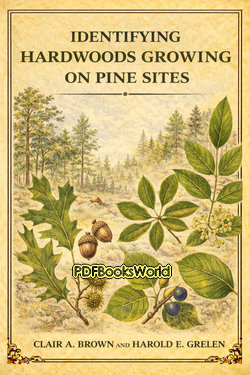
Identifying Hardwoods Growing on Pine Sites
by Clair A. Brown
Understanding Hardwood Species Found in Pine-Dominated Areas
Identifying Hardwoods Growing on Pine Sites by Clair A. Brown is a practical forestry guide devoted to recognizing hardwood trees that occur in areas commonly associated with pine forests. Written for foresters, land managers, students, and outdoor enthusiasts, the work addresses an important aspect of forest ecology: the coexistence of different tree species within the same environment.
Although pine stands are often viewed as uniform landscapes, they frequently contain a variety of hardwood species that contribute to the diversity, productivity, and long-term health of the forest. Brown's guide helps readers distinguish these trees through observable characteristics and field identification techniques.
Why Hardwood Identification Matters
Accurate tree identification is a fundamental skill in forestry and conservation. Different species respond differently to environmental conditions, management practices, and natural disturbances. Recognizing the hardwoods growing among pines allows land managers to make informed decisions about timber production, wildlife habitat, and forest regeneration.
Hardwoods can influence soil conditions, provide food sources for animals, and affect the overall structure of a woodland ecosystem. Understanding their presence helps create a more complete picture of forest dynamics.
For students and naturalists, tree identification also deepens appreciation for the complexity of forest communities.
Characteristics Used in Identification
Brown emphasizes practical observation rather than complicated scientific analysis. Many hardwood species can be recognized through features visible in the field.
- Leaf shape, size, and arrangement.
- Bark texture and coloration.
- Twigs, buds, and branching patterns.
- Fruits, nuts, or seed structures.
These characteristics often provide reliable clues even when trees are growing in mixed stands where multiple species occur together.
Hardwoods Within Pine Ecosystems
The presence of hardwoods on pine sites demonstrates that forests are rarely static environments. Competition, succession, climate, and soil conditions continually influence which species thrive in a given location.
Some hardwoods establish themselves beneath mature pine canopies, waiting for opportunities created by storms, harvesting, or natural tree mortality. Others occupy edges, openings, or moist areas where growing conditions differ from those preferred by pines.
Brown's work highlights how these species contribute to ecological diversity and how their distribution can reveal important information about site conditions.
A Field Guide for Forestry Professionals
One of the book's strengths is its practical focus. Rather than presenting forestry as a purely academic discipline, Brown provides information that can be applied directly in the field. Readers are encouraged to observe carefully, compare characteristics, and develop confidence in identifying trees under real-world conditions.
The guide reflects the needs of forestry professionals who must evaluate woodland composition quickly and accurately. Such knowledge is essential when planning harvests, assessing forest health, or conducting ecological surveys.
Its straightforward approach makes the material accessible even to readers with limited botanical experience.
The Broader Ecological Perspective
Beyond species identification, the book encourages a deeper understanding of forest relationships. Hardwood trees influence wildlife populations, nutrient cycling, and habitat structure. Their presence can indicate changes in environmental conditions and provide clues about the future development of a forest stand.
By studying these species, readers gain insight into how forests evolve over time and how different plants interact within shared ecosystems.
Final Thoughts
Identifying Hardwoods Growing on Pine Sites by Clair A. Brown is a useful and informative guide that combines practical field knowledge with ecological awareness. Through clear explanations and careful observation techniques, it helps readers recognize the hardwood species that coexist with pine forests and understand their role within broader woodland environments.
For those interested in forestry, botany, conservation, and natural history, the book provides a valuable introduction to tree identification while highlighting the diversity that exists within seemingly simple forest landscapes.
Similar Genres
About the Author
Clair A. Brown was an American forester, researcher, and author whose work contributed significantly to the study of forest ecology and tree identification. Through practical publications and scientific research, he helped landowners, students, and forestry professionals better understand the forests of North America and the relationships between different tree species. Explore Clair A. Brown books to discover the author's life, literary career, and access notable works.