
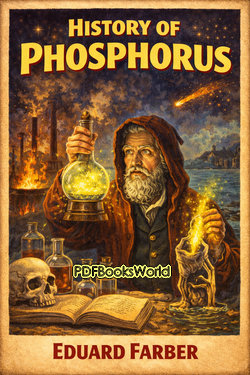
History of Phosphorus
by Eduard Farber
Alchemy, Scientific Discovery, and the Remarkable History of Phosphorus
History of Phosphorus by Eduard Farber is a historical study tracing the discovery, scientific investigation, and industrial importance of phosphorus from the age of alchemy to modern chemistry. The work explores how one unusual glowing substance became central to major developments in chemical theory, laboratory science, agriculture, medicine, and industrial technology.
Farber presents the history of phosphorus as part of the broader evolution of chemistry itself, revealing how scientific understanding gradually emerged from centuries of experimentation, curiosity, and changing theories about matter.
The Discovery of a Strange and Luminous Element
The book begins with the seventeenth-century discovery of phosphorus by the German alchemist Hennig Brand, who isolated the substance while attempting to create gold through alchemical experimentation.
Brand’s discovery astonished early investigators because phosphorus glowed in darkness and burst into flame under certain conditions, giving it an almost supernatural appearance.
Farber explains how the mysterious new material quickly attracted the attention of chemists and natural philosophers across Europe, becoming both a scientific curiosity and an important object of experimental investigation.
The work also traces how understanding of phosphorus gradually shifted from mystical interpretation toward systematic chemical analysis and scientific classification.
Its tone combines scientific history with intellectual curiosity and detailed historical scholarship.
Scientific and Historical Themes Explored Throughout the Book
- The Alchemical Origins of Phosphorus: Farber examines how accidental discovery during alchemical experimentation led to important scientific advances.
- The Development of Modern Chemistry: The book explores how phosphorus contributed to changing theories concerning combustion, oxidation, and chemical elements.
- Laboratory Experimentation and Scientific Method: Careful observation and experimentation gradually replaced mystical explanations of matter.
- Industrial and Biological Importance: Phosphorus later became essential in fertilizers, matches, medicine, and biological science.
The work reflects broader interest in the transformation of chemistry from alchemy into a modern experimental science.
Phosphorus and the Evolution of Chemical Theory
One of the book’s strongest ideas is that the history of a single element can reveal the broader intellectual development of scientific thought.
Farber repeatedly demonstrates how the study of phosphorus influenced changing ideas about combustion, atomic theory, and chemical classification.
The book also shows how discoveries once surrounded by secrecy and mystery gradually became integrated into systematic scientific knowledge.
This historical perspective gives the work lasting importance within the history of chemistry.
Eduard Farber’s Historical Scientific Style
History of Phosphorus demonstrates Eduard Farber’s ability to combine chemistry, scientific history, and cultural analysis into clear and engaging prose.
The writing remains scholarly, organized, and strongly focused upon explaining how scientific understanding evolves through experimentation, debate, and technological progress.
Farber consistently presents chemistry as a deeply human endeavor shaped by curiosity, imagination, and persistent investigation.
Why the Book Still Holds Interest Today
Modern readers continue finding History of Phosphorus fascinating because it reveals how one unusual element influenced the development of modern chemistry and industrial science.
The book also provides insight into the intellectual transition from alchemy and natural philosophy toward laboratory-based scientific investigation.
Phosphorus itself remains enormously important in agriculture, biology, medicine, and industry, making its historical development especially significant within the broader story of science.
For readers interested in chemistry, alchemy, scientific history, laboratory science, industrial development, and the evolution of modern scientific thought, this work remains historically revealing, intellectually rich, and scientifically engaging.
Similar Genres
About the Author
Eduard Farber was a German-born American historian of chemistry, educator, and author whose scholarship focused on the development of chemical science and the people behind its greatest discoveries. He believed that understanding the history of chemistry provided valuable insight into the evolution of scientific thought and the methods that shaped modern research. Explore Eduard Farber books to discover the author's life, literary career, and access notable works.