
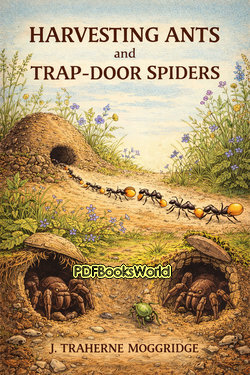
Harvesting Ants and Trap-Door Spiders
by J. Traherne Moggridge
Insect Societies, Natural Observation, and the Hidden Engineering of Small Creatures
Harvesting Ants and Trap-Door Spiders by J. Traherne Moggridge is a detailed natural history work exploring the remarkable behavior, architecture, and survival strategies of ants and trap-door spiders. Based upon careful field observation and scientific study, the book examines how these small creatures construct homes, gather resources, defend themselves, and adapt to their environments with extraordinary precision and instinct.
Moggridge presents insects and spiders not as insignificant animals, but as highly organized living beings whose behavior reveals surprising complexity and intelligence within the natural world.
The Organized World of Harvesting Ants
The book closely studies harvesting ants, particularly their methods of collecting seeds, constructing nests, maintaining colonies, and organizing labor. Moggridge describes how these ants create pathways, storage chambers, and underground systems while cooperating with remarkable efficiency.
He also examines their social behavior, division of labor, communication, and methods of protecting food supplies from environmental threats.
Rather than treating insect activity as random instinct alone, the work highlights patterns of organization that appear astonishingly systematic and purposeful.
The volume reflects the nineteenth century’s growing fascination with natural science, field observation, and animal behavior.
Its tone combines scientific precision with curiosity and admiration for the complexity of nature.
The Ingenious Architecture of Trap-Door Spiders
A major portion of the book examines trap-door spiders and the elaborate underground homes they construct. Moggridge carefully explains how these spiders create silk-lined tunnels hidden beneath perfectly camouflaged doors made from soil, leaves, and surrounding materials.
The spiders use these concealed entrances for protection, hunting, and survival against predators and environmental danger.
The work repeatedly emphasizes the extraordinary engineering skill displayed in these natural structures, which blend strength, concealment, and functional design.
This detailed study helped make trap-door spiders famous among naturalists and general readers alike.
Scientific and Natural History Topics Explored Throughout the Book
- Harvesting Ant Colonies: Moggridge studies food gathering, nest building, and social organization among ants.
- Trap-Door Spider Architecture: The book examines hidden burrows and protective engineering strategies.
- Animal Behavior and Adaptation: Instinct, survival methods, and environmental interaction are explored scientifically.
- Field Observation and Natural Science: Careful direct study forms the foundation of the work’s scientific approach.
- The Complexity of Small Creatures: Insects and spiders are presented as highly organized and adaptive living organisms.
The book became an important contribution to nineteenth-century natural history and observational zoology.
The Intelligence and Adaptability of Nature
One of the work’s strongest ideas is that even the smallest creatures display astonishingly effective survival mechanisms shaped by natural adaptation.
Moggridge repeatedly demonstrates how ants and spiders solve environmental problems through construction, cooperation, concealment, and instinctive behavior.
The book also reveals the growing scientific appreciation during the nineteenth century for studying animals in their natural habitats rather than solely through collected specimens.
This observational approach helped advance modern behavioral and ecological science.
J. Traherne Moggridge’s Observational Scientific Style
Harvesting Ants and Trap-Door Spiders demonstrates J. Traherne Moggridge’s remarkable patience and skill as a natural observer capable of describing tiny details of animal life with clarity and precision.
The writing remains descriptive, methodical, and strongly focused upon revealing the hidden complexity of natural systems.
Moggridge consistently presents scientific observation as both intellectual investigation and source of wonder.
Why the Book Still Holds Scientific and Natural History Interest
Modern readers continue finding Harvesting Ants and Trap-Door Spiders fascinating because it captures the careful observational spirit of classical natural history while documenting animal behaviors that remain impressive today.
The book also provides insight into nineteenth-century scientific exploration before modern behavioral ecology and advanced biological technologies transformed zoological research.
Its discussions of insect societies, spider engineering, instinct, and environmental adaptation continue attracting readers interested in entomology and animal behavior.
For readers interested in natural history, entomology, zoology, ecology, animal architecture, behavioral science, and Victorian scientific observation, this work remains scientifically valuable, historically revealing, and deeply fascinating.
Similar Genres
About the Author
J. Traherne Moggridge, formally John Traherne Moggridge, was an English naturalist, botanist, entomologist, and author whose careful observations of plants and animals made important contributions to nineteenth-century natural history. A passionate field researcher, he spent countless hours studying the behavior of insects, spiders, and Mediterranean plant life in their natural environments. Explore J. Traherne Moggridge books to discover the author's life, literary career, and access notable works.