
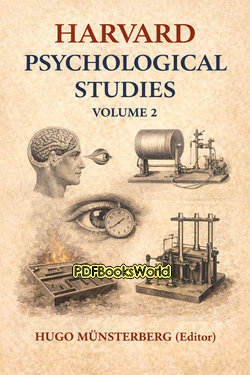
Harvard Psychological Studies, Volume 2
by Hugo Munsterberg
A Collection of Early Experimental Research in Psychology
Harvard Psychological Studies (Vol. 2) by Hugo Münsterberg is a scholarly collection of psychological research produced during the formative years of experimental psychology in the United States. As director of Harvard University's psychological laboratory, Münsterberg helped establish psychology as a scientific discipline grounded in observation, measurement, and experimentation. This volume gathers studies conducted under his supervision, reflecting the methods and questions that occupied psychologists at the beginning of the twentieth century.
The work provides a valuable historical record of how researchers investigated the human mind before the development of many modern psychological theories and technologies. It demonstrates the growing effort to apply scientific methods to the study of perception, attention, memory, learning, and behavior.
The Rise of Scientific Psychology
During the late nineteenth and early twentieth centuries, psychology was evolving from a branch of philosophy into an independent scientific field. Researchers sought to understand mental processes through carefully designed experiments rather than relying solely on speculation or introspection.
This volume reflects that transition by presenting studies that emphasize observation, data collection, and controlled investigation.
Research Topics and Experiments
The collection includes investigations into various aspects of mental activity. Researchers explored how people perceive sensory information, how attention is directed and maintained, how memories are formed, and how responses to different stimuli can be measured.
These studies illustrate the range of questions psychologists were attempting to answer as they established the foundations of their discipline.
Highlights of the Volume
- Experimental Research: Studies based on observation and measurement.
- Psychological Inquiry: Exploration of perception, memory, and attention.
- Scientific Method: Early use of laboratory techniques in psychology.
- Academic Scholarship: Contributions from Harvard researchers.
- Historical Importance: Insight into the development of modern psychology.
The Laboratory Approach
A defining feature of the volume is its emphasis on laboratory experimentation. Rather than discussing psychological concepts in purely theoretical terms, the studies seek measurable evidence through carefully structured tests and observations.
This approach helped establish psychology as a discipline capable of producing empirical knowledge.
Major Themes
- Observation: Understanding mental processes through evidence.
- Measurement: Quantifying psychological phenomena.
- Attention: Investigating focus and concentration.
- Perception: Examining how individuals experience the world.
- Scientific Progress: Building knowledge through experimentation.
Hugo Münsterberg's Influence
Hugo Münsterberg was one of the most influential psychologists of his era. His work contributed to educational psychology, industrial psychology, forensic psychology, and experimental research. Through his leadership at Harvard, he encouraged the application of scientific methods to a wide range of psychological questions.
His efforts helped shape the development of psychology as a modern academic and scientific discipline.
Why the Volume Remains Significant
Harvard Psychological Studies (Vol. 2) remains valuable as a historical document that captures psychology during a period of rapid growth and transformation. Although many findings and methods have been refined by later research, the volume reveals the intellectual foundations upon which modern psychology was built.
For readers interested in the history of science, experimental research, and the evolution of psychological thought, the book offers a fascinating glimpse into the early efforts to understand the workings of the human mind. Its scholarly importance and historical perspective ensure its enduring relevance.
Similar Genres
About the Author
Hugo Münsterberg was a German-American psychologist, philosopher, and educator whose pioneering research helped shape the development of modern applied psychology. Renowned for his work in experimental psychology, industrial psychology, educational psychology, and forensic psychology, he believed that scientific methods could be used to better understand human thought, behavior, and performance. Explore Hugo Munsterberg books to discover the author's life, literary career, and access notable works.