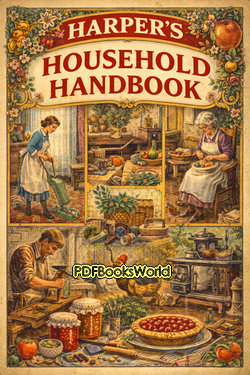
Harper's Household Handbook
by Anonymous
A Comprehensive Guide to Domestic Life and Practical Household Management
Harper's Household Handbook by Anonymous is a practical domestic guide offering advice on household management, cooking, cleanliness, organization, etiquette, and everyday living. Designed for families and homemakers, the book reflects the importance of domestic efficiency and practical knowledge within nineteenth-century and early twentieth-century home life.
The handbook belongs to a tradition of instructional household manuals that aimed to provide reliable guidance for managing the many responsibilities connected to maintaining a comfortable and orderly home. Such works often combined practical instruction with moral and social expectations concerning family life and domestic responsibility.
The book serves both as a useful manual and as a historical portrait of everyday domestic culture.
Managing the Home and Daily Responsibilities
The handbook likely covers a wide variety of subjects related to domestic life, including meal preparation, cleaning methods, laundry, household organization, budgeting, childcare, health remedies, and etiquette. Advice is presented to help readers maintain efficiency, comfort, and proper household order.
Many sections reflect a period when homes relied heavily upon personal skill, routine labor, and careful management before the arrival of modern household technology.
The work emphasizes practicality, discipline, and resourcefulness in everyday living.
The Clear and Instructional Style of the Handbook
The writing style is direct, organized, and practical, focusing on useful advice rather than literary storytelling. Instructions are intended to remain understandable and applicable for ordinary households.
The tone reflects the educational purpose of household manuals, where practical knowledge and social expectations were closely connected.
The handbook’s accessible structure helped make such books valuable references within family life.
Main Themes and Domestic Interests
The book explores themes of household management, practical education, family responsibility, cleanliness, efficiency, and domestic organization. It also reflects historical ideas about the role of the home as a center of social stability and moral order.
Through practical instruction, the handbook presents domestic labor as both necessary skill and important social responsibility.
Why the Book Still Holds Interest
Harper's Household Handbook remains historically interesting because it preserves details about everyday domestic practices and social expectations from an earlier era. Readers interested in household history and domestic culture often appreciate such manuals for their insight into ordinary life before modern conveniences became widespread.
The book also reveals how practical knowledge was taught and shared within homes and families.
Its detailed advice and historical perspective continue to make it valuable for cultural study.
The Lasting Importance of Domestic Manuals
Household manuals became extremely popular during the nineteenth century because families relied heavily upon printed guides for cooking, cleaning, health, etiquette, and household organization. Such books helped standardize domestic practices and reflected changing ideas about family life and social responsibility.
Domestic guides also documented the skills required to manage homes efficiently before technological modernization transformed daily labor.
The continuing interest in social history and vintage domestic culture helps preserve appreciation for works like this.
Final Thoughts
Harper's Household Handbook by Anonymous is a practical and historically valuable guide exploring the many responsibilities connected to home management and domestic life. Through accessible instruction and organized advice, the book captures the routines, expectations, and practical skills that shaped everyday household culture in an earlier era.
For readers interested in domestic history, household organization, vintage manuals, and social history, this work remains both informative and historically fascinating.