
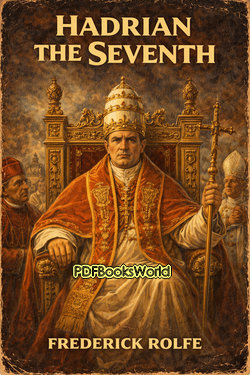
Hadrian the Seventh
by Frederick Rolfe
An Unlikely Pope and a Vision of Personal Triumph
Hadrian the Seventh by Frederick Rolfe, writing under the name Baron Corvo, is one of the most unusual and memorable novels of the early twentieth century. First published in 1904, the book tells the story of George Arthur Rose, an impoverished English writer and failed candidate for the priesthood who suddenly finds himself elevated to the highest position in the Roman Catholic Church. Through this extraordinary premise, Rolfe creates a novel that blends satire, fantasy, politics, religion, and personal wish fulfillment.
The novel is widely regarded as Rolfe's masterpiece and remains his best-known work. What makes it especially fascinating is the close connection between the author and his protagonist. Many critics have noted that George Arthur Rose serves as a fictional version of Rolfe himself, allowing the author to imagine a world in which his frustrations, ambitions, and grievances are dramatically transformed into triumph.
From Rejection to the Papal Throne
At the beginning of the novel, George Arthur Rose lives a lonely and disappointing life. His hopes of becoming a priest have been crushed, and he struggles financially while feeling misunderstood and neglected. Then an astonishing opportunity appears. Church leaders acknowledge past mistakes, restore his standing, and bring him to Rome during a deadlocked papal election. Against all expectations, Rose is chosen as Pope and adopts the name Hadrian VII.
This dramatic transformation provides the foundation for the rest of the story. Instead of remaining a powerless outsider, Rose suddenly possesses enormous authority and the ability to reshape institutions, reward allies, and pursue reforms he believes are necessary.
A Vision of Reform and Authority
Once elected pope, Hadrian VII sets out to reform both the Church and the wider world. He challenges established traditions, confronts opponents, and seeks solutions to political and social problems. His actions reveal a leader who is both idealistic and authoritarian, compassionate and uncompromising.
Rolfe presents Hadrian as a figure full of contradictions. He can be generous and harsh, humble and proud, visionary and stubborn. These complexities make the character far more interesting than a simple hero or villain.
Major Themes Found Throughout the Novel
- Wish Fulfillment: The fantasy of overcoming rejection and achieving ultimate success.
- Power and Reform: The opportunities and dangers that accompany authority.
- Religion and Politics: The relationship between spiritual leadership and worldly affairs.
- Identity: The struggle to define oneself despite misunderstanding and opposition.
These themes help explain why the novel remains intriguing more than a century after its publication.
A Strongly Personal Work
One of the most distinctive aspects of Hadrian the Seventh is its autobiographical nature. Rolfe had himself been rejected from religious training and often felt overlooked by the institutions he admired. The novel allowed him to imagine an alternative future in which those perceived injustices were corrected and his talents fully recognized. Critics frequently describe the book as one of literature's most remarkable examples of personal fantasy transformed into art.
This personal element gives the novel an emotional intensity that sets it apart from many other satirical or political works of its era.
Style and Literary Reputation
Rolfe's writing style is distinctive, filled with elaborate language, strong opinions, and vivid characterizations. The novel combines serious discussions of religion and governance with moments of humor, irony, and eccentricity. Its unusual blend of fantasy and realism has attracted devoted readers for generations.
The book's reputation has grown steadily over time. It has been praised as a unique literary achievement and continues to be recognized as one of the most original novels of the twentieth century.
Why Readers Continue to Discover It
- Original Premise: An unlikely outsider becomes pope and reshapes the world.
- Memorable Character: Hadrian VII is complex, flawed, and fascinating.
- Historical Interest: The novel offers insight into religion, politics, and society in the early 1900s.
- Literary Uniqueness: Few novels combine fantasy, satire, autobiography, and social commentary so effectively.
Why Hadrian the Seventh Remains Important
Hadrian the Seventh continues to captivate readers because it is far more than a story about an unexpected pope. It is a meditation on ambition, recognition, authority, and the desire to correct perceived wrongs. Through the unforgettable figure of Hadrian VII, Frederick Rolfe created a novel that is at once deeply personal, highly imaginative, and remarkably entertaining. Its blend of fantasy and self-reflection ensures its place as one of the most distinctive works in modern English literature.
Similar Genres
About the Author
Frederick Rolfe, better known by his self-chosen pen name Baron Corvo, was an English novelist, artist, photographer, and eccentric literary figure whose imaginative works have earned a lasting place in English literature. His fiction blends wit, satire, symbolism, and psychological insight, often drawing upon his deep interest in religion, history, and Renaissance culture. Explore Frederick Rolfe books to discover the author's life, literary career, and access notable works.