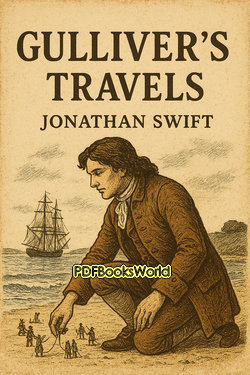
Gulliver's Travels
by Jonathan Swift
Gulliver’s Travels – A Brilliant Adventure Filled with Satire and Imagination
Some novels entertain readers with adventure. Others challenge society through sharp observation and wit. Gulliver’s Travels by Jonathan Swift accomplishes both, making it one of the most remarkable classics in English literature.
Originally published in 1726, the novel follows the extraordinary journeys of Lemuel Gulliver, a traveler who encounters strange civilizations, tiny kingdoms, giants, and unusual societies that reflect the strengths and weaknesses of humanity itself.
A Journey Beyond Ordinary Adventure
At first glance, Gulliver’s Travels appears to be a fantasy adventure filled with imaginative worlds and unforgettable encounters. Readers follow Gulliver as he travels through:
- Lilliput, a land of tiny people
- Brobdingnag, a kingdom of giants
- Laputa, a floating island obsessed with science and theory
- The land of the Houyhnhnms, where intelligent horses rule over savage human-like creatures
Each voyage presents excitement and wonder, but Jonathan Swift uses these fictional worlds to deliver deeper commentary about politics, pride, human behavior, and society.
Why Gulliver’s Travels Still Matters Today
One reason the novel continues to attract readers centuries later is its timeless satire. Swift exposes hypocrisy, greed, political conflict, and human arrogance through humor and exaggeration.
Modern readers are often surprised by how relevant many of the book’s ideas still feel in today’s world. Beneath the fantasy and adventure lies a thoughtful examination of human nature and the flaws within civilization.
More Than a Children’s Story
Although many people first encounter Gulliver’s Travels as a children’s tale, the novel was originally written as a sophisticated political and social satire. Literary scholars consider it one of the greatest satirical works ever created.
Younger readers enjoy the imaginative settings and unusual characters, while adult readers often appreciate the deeper symbolism and criticism hidden within the narrative.
Jonathan Swift’s Unique Writing Style
Jonathan Swift combined humor, irony, fantasy, and realism in a way that transformed English literature. His storytelling feels vivid and believable even when describing impossible worlds and extraordinary situations.
The novel’s first-person narration allows readers to experience Gulliver’s discoveries directly, making each voyage feel immersive and emotionally engaging.
The Lasting Influence of Gulliver’s Travels
Over the centuries, Gulliver’s Travels has inspired films, television adaptations, stage productions, illustrations, and countless literary discussions. Characters and places such as the Lilliputians have become part of global popular culture.
The novel also played an important role in shaping the development of modern satire and adventure fiction.
A Classic Worth Reading
Readers interested in classic literature, fantasy adventures, political satire, or philosophical fiction will find Gulliver’s Travels both entertaining and intellectually rewarding.
Jonathan Swift’s masterpiece continues to stand as a powerful exploration of imagination, society, and the complexities of human nature, proving why it remains one of the most enduring classics ever written.
Similar Genres
About the Author

Jonathan Swift was an Irish writer, satirist, essayist, poet, and clergyman whose brilliant wit and sharp social criticism made him one of the greatest authors in the English language. Born in Dublin in 1667, Swift became renowned for using humor, irony, and imaginative storytelling to expose political corruption, human folly, and social injustice. Explore Jonathan Swift books to discover the author's life, literary career, and access notable works, including A Modest Proposal , and more.