
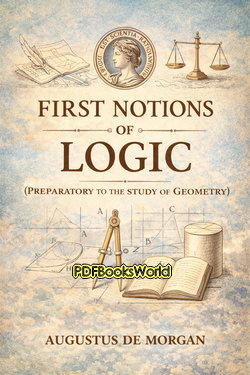
First notions of logic
by Augustus De Morgan
An Accessible Introduction to the Principles of Reasoning
First Notions of Logic by Augustus De Morgan is a concise and influential introduction to the study of logic, written by one of the nineteenth century's most respected mathematicians and thinkers. Designed for beginners, the book explains the basic principles of reasoning and argument in a clear and approachable manner. De Morgan believed that logical thinking was an essential skill for everyday life, and this work reflects his commitment to making intellectual subjects accessible to a broad audience.
Rather than treating logic as a specialized academic discipline, the book presents it as a practical tool for understanding ideas, evaluating arguments, and avoiding errors in reasoning. Its straightforward style makes it an excellent starting point for readers encountering the subject for the first time.
What Is Logic?
At its core, logic is the study of correct reasoning. De Morgan explains how people form judgments, draw conclusions, and evaluate evidence. By understanding the principles that govern sound reasoning, readers can become more effective thinkers and communicators.
The book emphasizes that logic is not merely about abstract theories. It has practical applications in education, discussion, decision-making, and everyday problem-solving.
Learning to Think Clearly
A major goal of the work is to help readers recognize the difference between valid and faulty arguments. De Morgan illustrates how conclusions should follow from evidence and how mistakes in reasoning can lead to incorrect beliefs.
Through examples and explanations, he demonstrates that careful thinking requires attention to definitions, assumptions, and relationships between ideas.
Key Topics Covered
- Reasoning: How conclusions are drawn from evidence.
- Arguments: Understanding the structure of logical claims.
- Definitions: The importance of clear and precise language.
- Judgment: Evaluating statements and ideas critically.
- Logical Errors: Recognizing common mistakes in reasoning.
The Practical Value of Logic
De Morgan viewed logic as a discipline that could improve everyday life. People constantly encounter claims, opinions, and arguments, and logical thinking helps them assess these more effectively. The ability to reason carefully can lead to better decisions and clearer communication.
This practical emphasis distinguishes the book from more technical works. Readers are encouraged to apply logical principles to real situations rather than treating them as purely theoretical concepts.
Major Themes
- Clarity: Clear thinking begins with clear understanding.
- Reason: Evidence and logic should guide conclusions.
- Education: Intellectual skills can be developed through study.
- Critical Thinking: Questioning assumptions and evaluating arguments.
- Precision: Careful language supports accurate reasoning.
Augustus De Morgan's Contribution
Augustus De Morgan was a pioneering mathematician and logician whose work influenced later developments in both fields. He had a talent for explaining difficult subjects in a way that ordinary readers could understand. In First Notions of Logic, he applies that skill to one of the most fundamental areas of human thought.
His approach reflects a belief that logical reasoning should be part of general education rather than restricted to specialists.
Why the Book Remains Worth Reading
First Notions of Logic continues to be valuable because the ability to think clearly and evaluate arguments remains essential in every era. Although written in the nineteenth century, its lessons about reasoning, evidence, and critical analysis remain highly relevant.
For readers interested in philosophy, education, mathematics, or critical thinking, the book provides an excellent introduction to the foundations of logic. Its clear explanations and practical focus make it a rewarding guide to one of the most important tools of human understanding.
Similar Genres
About the Author
Augustus De Morgan was a British mathematician, logician, educator, and writer whose pioneering work laid important foundations for modern symbolic logic and mathematical reasoning. As one of the nineteenth century's most influential scholars, De Morgan helped transform logic from a branch of philosophy into a rigorous analytical discipline. Explore Augustus De Morgan books to discover the author's life, literary career, and access notable works.