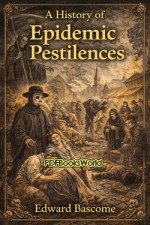
Edward Bascome
Edward Bascome was a British physician and medical writer whose work focused on understanding disease, public health, and the history of medicine. Writing during the nineteenth century, he sought to explain the causes and patterns of widespread illnesses by examining historical records, medical observations, and scientific knowledge available in his time. His publications reflected a growing interest in studying epidemics not only as medical events but also as forces that shaped societies, economies, and human history. A History of Epidemic Pestilences remains his best-known work, offering readers a detailed examination of major outbreaks and their lasting impact on civilization.
A Physician Interested in Medical History
Edward Bascome believed that understanding the past could help improve the future of medicine. As a physician, he recognized that epidemics had repeatedly transformed communities, influenced governments, and challenged medical knowledge. By studying earlier outbreaks, he hoped to identify patterns that could contribute to a better understanding of disease and public health.
His writing combined medical observation with historical research, making his work valuable to both healthcare professionals and readers interested in history. Rather than limiting his discussion to clinical details, Bascome examined the broader social and environmental circumstances surrounding major epidemics.
Documenting the World's Great Epidemics
Bascome approached the history of disease with careful attention to historical sources and available medical evidence. He explored how outbreaks spread across countries, how communities responded, and how medical ideas evolved over time. His work highlighted the challenges faced by physicians before the development of modern medical science and demonstrated how knowledge gradually advanced through observation and experience.
His straightforward writing style made complex medical topics understandable for general readers. By presenting historical events in a logical sequence, he encouraged readers to appreciate both the scientific and human dimensions of epidemic disease.
His Contribution to Medical Literature
Edward Bascome contributed to a growing body of nineteenth-century medical scholarship that emphasized the importance of historical research. His work helped preserve valuable accounts of past epidemics, allowing later generations to study how societies responded to public health crises. Although many medical explanations from his era have since been revised through modern scientific discoveries, his historical documentation remains an important resource for understanding the development of epidemiology and public health.
His writings also demonstrated that medicine extends beyond treating individual patients. By examining the wider effects of disease on populations, governments, and communities, Bascome showed how health and history are closely connected.
An Enduring Historical Resource
Today, Edward Bascome's work continues to interest historians of medicine, researchers, and readers exploring the history of epidemic diseases. His careful compilation of historical accounts provides valuable insight into how earlier generations understood and responded to widespread illness. While modern epidemiology relies on far more advanced scientific methods, Bascome's historical perspective remains useful for appreciating the long struggle against infectious disease.
His work also reminds readers that epidemics have repeatedly shaped the course of human history, influencing social change, scientific progress, and public health policy. These historical lessons continue to hold significance in the modern world.
A History of Epidemic Pestilences stands as Edward Bascome's most significant contribution to medical history, preserving important accounts of some of history's most devastating outbreaks. PDF Books World carefully curates editions of his classic works, allowing modern readers to explore historical studies that illuminate the evolution of medicine, public health, and humanity's ongoing efforts to understand disease.