
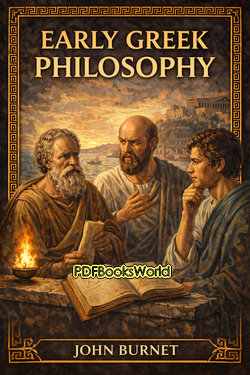
Early Greek philosophy
by John Burnet
An Essential Introduction to the Origins of Western Thought
Early Greek Philosophy by John Burnet is a landmark study of the thinkers who laid the foundations of Western philosophy. One of the foremost classical scholars of his time, Burnet examines the ideas of the pre-Socratic philosophers, whose efforts to understand the nature of the universe marked a significant departure from mythological explanations of the world. The book traces the development of rational inquiry in ancient Greece and highlights the intellectual achievements of the philosophers who paved the way for Socrates, Plato, and Aristotle.
Rather than relying on traditional myths to explain natural phenomena, these early thinkers sought answers through observation, reasoning, and speculation. Their ideas helped establish philosophy and science as distinct forms of inquiry.
The Birth of Rational Thought
One of the book's central themes is the emergence of rational thinking. Early Greek philosophers attempted to identify the underlying principles governing the universe. They asked fundamental questions about matter, change, existence, and knowledge, creating a new approach to understanding reality.
This shift from mythological storytelling to systematic reasoning represents one of the most important developments in intellectual history.
The Milesian Philosophers
Burnet begins with thinkers such as Thales, Anaximander, and Anaximenes, who lived in the Greek city of Miletus. These philosophers sought natural explanations for the structure of the world and proposed that all things originated from a fundamental substance or principle.
Their efforts marked the beginning of scientific and philosophical investigation in the Western tradition.
Heraclitus and the Nature of Change
Among the most influential figures discussed is Heraclitus, who argued that change is a constant feature of reality. He believed that the universe is characterized by continual transformation and that apparent stability conceals an underlying process of movement and development.
His ideas encouraged later philosophers to think deeply about the relationship between permanence and change.
Pythagoras and Mathematical Order
The book also examines Pythagoras and his followers, who viewed numbers and mathematical relationships as the key to understanding the universe. Their discoveries influenced philosophy, mathematics, music, and science, demonstrating the power of abstract reasoning.
The Pythagoreans introduced concepts that would remain important throughout the history of intellectual thought.
Highlights of the Book
- Pre-Socratic Thinkers: The philosophers who preceded Socrates.
- Origins of Science: Early attempts to explain nature rationally.
- Metaphysical Questions: Investigations into existence and reality.
- Intellectual History: The development of philosophical inquiry.
- Classical Scholarship: Careful analysis of ancient sources.
Major Themes
- Reason: Using logic to understand the world.
- Nature: Seeking explanations for physical reality.
- Knowledge: Investigating how truth can be discovered.
- Change and Permanence: Understanding the structure of existence.
- Inquiry: The importance of questioning accepted beliefs.
John Burnet's Contribution
John Burnet was one of the leading scholars of ancient philosophy, and his work helped establish the study of pre-Socratic thought as a serious academic field. He carefully examined surviving fragments and historical accounts to reconstruct the ideas of philosophers whose original writings often exist only in part.
His scholarship made these early thinkers more accessible to students and general readers while emphasizing their importance in the history of ideas.
Why the Book Remains Significant
Early Greek Philosophy remains an essential resource for anyone interested in the origins of Western intellectual tradition. It demonstrates how ancient thinkers began asking questions that continue to shape philosophy, science, and human understanding today.
For readers interested in philosophy, history, and the development of rational inquiry, the book offers a fascinating journey into the minds of the pioneers who first sought to explain the universe through reason rather than myth. Its exploration of enduring questions ensures its lasting importance and appeal.
Similar Genres
About the Author
John Burnet was a Scottish classical scholar, historian of philosophy, and professor whose pioneering studies of ancient Greek thought established him as one of the foremost authorities on early philosophy. Through meticulous scholarship and careful analysis of classical texts, Burnet illuminated the ideas of the Pre-Socratic philosophers and the intellectual foundations of Western philosophy. Explore John Burnet books to discover the author's life, literary career, and access notable works.