
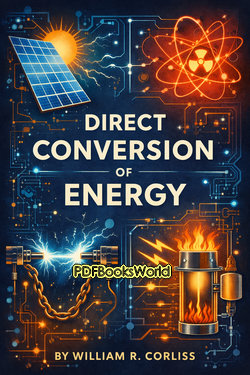
Direct Conversion of Energy
by William R. Corliss
Exploring Alternative Paths to Power Generation
Direct Conversion of Energy by William R. Corliss is a scientific and technological study that examines methods of transforming energy from one form into another without relying on the traditional mechanical processes commonly used in power generation. Written during a period of growing interest in advanced energy technologies, the work explores concepts that promised greater efficiency, reduced complexity, and new possibilities for industrial and scientific applications.
Rather than focusing solely on conventional engines and turbines, Corliss investigates systems capable of producing electricity or useful power through more direct means. The book serves as both an introduction to emerging technologies and a survey of scientific research aimed at improving the way energy is harnessed and utilized.
The Traditional Approach to Energy Conversion
For much of modern history, power generation depended upon a sequence of energy transformations. Fuel would be burned to produce heat, heat would generate steam, and steam would drive mechanical equipment that ultimately produced electricity.
While effective, such systems involve multiple stages, each introducing energy losses. Engineers and scientists therefore became interested in methods that could bypass some of these intermediate steps and convert energy more directly into usable electrical power.
This search for efficiency forms the foundation of Corliss's study.
What Is Direct Energy Conversion?
Direct energy conversion refers to technologies that transform energy from one form to another without requiring large moving mechanical components. Instead of relying on rotating machinery, these systems often exploit physical principles involving heat, light, chemical reactions, or atomic processes.
The book examines a variety of approaches that were attracting scientific attention, including techniques designed to improve efficiency and expand the range of practical energy sources.
By reducing mechanical complexity, such systems offered the potential for greater reliability and specialized applications.
Technologies Discussed in the Study
Corliss surveys several forms of direct conversion technology, explaining the scientific principles behind each and evaluating their potential uses.
- Thermoelectric systems that convert heat directly into electricity.
- Photovoltaic devices that transform sunlight into electrical energy.
- Fuel cells that generate electricity through chemical reactions.
- Advanced experimental methods involving atomic and plasma processes.
These technologies represented important areas of research and pointed toward possible future developments in energy production.
William R. Corliss and Technical Communication
William R. Corliss was recognized for his ability to explain complex scientific and engineering subjects in a clear and organized manner. His work often served as a bridge between specialized research and broader technical audiences.
In Direct Conversion of Energy, he combines scientific principles with practical discussion, helping readers understand both the opportunities and limitations associated with emerging technologies.
This balanced approach makes the book valuable not only for engineers but also for readers interested in the future of science and technology.
The Promise of Greater Efficiency
A major theme throughout the book is efficiency. Every energy conversion process involves some loss, and reducing those losses has long been a central goal of engineering.
Direct conversion technologies attracted attention because they offered the possibility of simplifying power systems and improving performance under specific conditions. Although many approaches remained experimental at the time, they demonstrated the creative efforts being made to rethink conventional methods of energy generation.
The work highlights the importance of innovation in addressing technological challenges.
Historical Significance
Viewed today, the book provides a fascinating snapshot of mid-twentieth-century scientific optimism. Many of the technologies discussed were still developing, yet researchers believed they could play important roles in future energy systems.
Some concepts examined by Corliss, particularly solar energy and fuel cells, later became significant components of modern energy research and commercial applications. Others remained largely experimental but contributed valuable knowledge to the field.
The book therefore offers insight into the evolution of energy science and engineering.
Final Thoughts
Direct Conversion of Energy by William R. Corliss is an informative exploration of technologies designed to transform energy more efficiently and directly than traditional power-generation methods. By examining innovative scientific approaches and their potential applications, Corliss provides readers with a thoughtful overview of an important area of technological research.
For readers interested in engineering, energy systems, technological innovation, and the history of scientific development, this work remains a valuable introduction to the quest for more effective ways of harnessing power.
Similar Genres
About the Author
William R. Corliss was an American physicist, aerospace engineer, technical writer, and researcher whose career combined scientific expertise with a remarkable ability to communicate complex technological ideas to a broad audience. He worked on important aerospace projects before becoming widely known for his books explaining scientific principles and documenting unusual scientific observations. Explore William R. Corliss books to discover the author's life, literary career, and access notable works.