
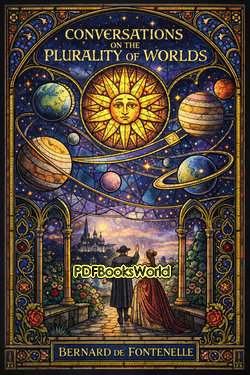
Conversations on the Plurality of Worlds
by Bernard de Fontenelle
A Classic Introduction to Astronomy and the Possibility of Other Worlds
Conversations on the Plurality of Worlds by Bernard de Fontenelle is one of the most influential popular science works of the early modern period. First published in 1686, the book presents contemporary astronomical ideas through a series of elegant conversations between a philosopher and a noblewoman. Combining scientific explanation with wit and imagination, Fontenelle introduces readers to the revolutionary concept that the universe may contain countless inhabited worlds beyond Earth.
A New Vision of the Universe
At a time when traditional views of the cosmos were being challenged by new discoveries, Fontenelle sought to make astronomy understandable to a general audience. Drawing upon the ideas of thinkers such as Copernicus and others who supported a Sun-centered universe, he described a cosmos far larger and more complex than many people had previously imagined.
The book helped popularize scientific ideas that were transforming humanity's understanding of its place in creation.
Major Subjects Covered
- Astronomy: Explanations of planetary motion and the structure of the universe.
- The Copernican System: The concept of Earth orbiting the Sun.
- Plurality of Worlds: The possibility that other planets may be inhabited.
- Scientific Inquiry: The value of observation and rational investigation.
- Philosophy: Reflections on humanity's place in the cosmos.
The Conversational Format
One of the book's most distinctive features is its structure. Rather than presenting scientific information as a formal treatise, Fontenelle conveys ideas through a series of engaging conversations. This approach makes complex topics more accessible and allows scientific concepts to emerge naturally through discussion and questioning.
The style contributed greatly to the work's popularity.
The Idea of Other Inhabited Worlds
Fontenelle explores the possibility that planets and stars beyond Earth might support life. Although he lacked the scientific evidence available today, he argued that it was reasonable to imagine other worlds populated by intelligent beings. This speculation captured the imagination of readers and encouraged broader thinking about the universe.
The concept would later become a recurring theme in science and literature.
Bernard de Fontenelle's Contribution
Fontenelle was a French author, philosopher, and science popularizer who played a major role in bringing scientific ideas to wider audiences. He possessed a rare ability to explain difficult concepts in clear and entertaining language, helping bridge the gap between scholars and the general public.
His work contributed significantly to the spread of scientific knowledge during the Enlightenment.
Science and Imagination
Although grounded in astronomy, the book also demonstrates the importance of imagination in scientific thought. Fontenelle encourages readers to look beyond familiar assumptions and consider possibilities suggested by reason and observation. This balance between fact and speculation gives the work much of its enduring charm.
It invites curiosity rather than demanding certainty.
A Landmark in Popular Science
The book is often regarded as one of the earliest successful examples of popular science writing. It showed that scientific subjects could be presented in a manner that was both educational and entertaining, influencing later generations of science communicators.
Its impact extended well beyond the field of astronomy.
Why the Book Remains Important
Readers interested in the history of science, astronomy, philosophy, and the development of scientific thought continue to find value in Fontenelle's work. While modern astronomy has advanced far beyond the knowledge available in the seventeenth century, the book remains significant for its intellectual boldness and historical influence.
Its celebration of curiosity and exploration continues to resonate today.
A Pioneering Exploration of the Cosmos
Conversations on the Plurality of Worlds stands as a landmark achievement in the history of scientific literature. Through graceful dialogue and imaginative reasoning, Bernard de Fontenelle introduced generations of readers to a vast universe filled with possibilities. The book remains a fascinating blend of science, philosophy, and wonder, reflecting humanity's enduring desire to understand the heavens and our place within them.
Similar Genres
About the Author
Bernard le Bovier de Fontenelle was a French philosopher, scientist, essayist, and man of letters whose writings helped make scientific ideas accessible to the general public during the Age of Enlightenment. Renowned for his ability to explain complex subjects with clarity and elegance, Fontenelle served as a bridge between the scientific community and ordinary readers. Explore Bernard de Fontenelle books to discover the author's life, literary career, and access notable works.