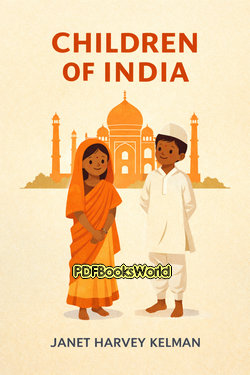
Children of India
by Janet Harvey Kelman
Childhood, Tradition, and Everyday Life in Early Twentieth-Century India
Children of India by Janet Harvey Kelman is an educational and cultural study introducing young readers to the lives, customs, beliefs, and experiences of Indian children during the early twentieth century. Written as part of a broader tradition of educational literature for younger audiences, the book combines storytelling, observation, and cultural explanation while attempting to present India’s landscapes, religions, family life, and social traditions in an accessible and engaging manner.
Kelman presents India not simply as a distant colony within the British Empire, but as a richly layered civilization shaped by ancient traditions, spiritual beliefs, and diverse regional cultures.
The Lives of Indian Children
The book explores how children in India grow up within environments strongly influenced by religion, family structure, festivals, storytelling, and long-established social customs. Kelman describes homes, schools, clothing, food, games, ceremonies, and daily routines while emphasizing the importance of Hindu beliefs and cultural traditions in shaping childhood experiences.
Particular attention is given to the sacred stories and religious ideas surrounding rivers, temples, gods, and heroic figures that form part of the cultural imagination of many Indian communities. The River Ganges, for example, is presented not merely as a geographical feature, but as a sacred symbol deeply connected to spiritual life and identity.
Rather than focusing entirely upon political events or colonial administration, the work attempts to portray everyday human experience through the perspective of children and family life.
The volume reflects early twentieth-century Western interest in introducing foreign cultures to younger readers through educational narrative and descriptive travel-style writing.
Its tone combines curiosity, instruction, and cultural storytelling.
Culture, Religion, and Social Tradition
A major theme throughout the book is the close relationship between spiritual belief and daily life within Indian society. Kelman repeatedly explains how religious customs influence festivals, social behavior, family duties, and childhood education.
The work also discusses caste, sacred geography, and community traditions while attempting to explain complex social systems to younger readers in understandable language.
Although written from the perspective of its historical period, the book remains valuable as a reflection of how India was interpreted and introduced to English-speaking audiences during the early twentieth century.
This combination of cultural observation and educational purpose gives the work historical significance.
Cultural and Educational Themes Explored Throughout the Book
- Childhood in India: The book examines family life, education, customs, and daily experiences.
- Religion and Spiritual Tradition: Hindu beliefs and sacred stories strongly shape society and culture.
- Family and Community: Social identity develops through household and communal traditions.
- Cultural Education: The work introduces Indian life to young Western readers.
- Tradition and Social Structure: Customs and inherited beliefs influence personal and social behavior.
The book stands as both educational literature and historical cultural interpretation.
The Importance of Understanding Other Cultures
One of the work’s strongest ideas is that learning about distant cultures broadens understanding and encourages curiosity about the wider world.
Kelman repeatedly demonstrates how stories, traditions, and family customs help shape the identity of children everywhere despite differences in geography or religion.
The book also reveals the educational priorities of its era, when children’s literature often aimed to combine moral instruction with cultural knowledge.
This perspective gives the work continuing historical and literary interest.
Janet Harvey Kelman’s Educational Writing Style
Children of India demonstrates Janet Harvey Kelman’s ability to combine descriptive explanation, storytelling, and accessible educational writing for younger audiences. Kelman herself was a Scottish educator and writer known for works introducing nature, history, and world cultures to children.
The writing remains clear, organized, and strongly focused upon making unfamiliar customs understandable and engaging for readers.
Kelman consistently presents cultural learning as an important part of education and imagination.
Why the Book Still Holds Historical and Cultural Interest
Modern readers continue finding Children of India valuable because it preserves early twentieth-century perspectives on Indian society, childhood, and educational storytelling.
The book also provides insight into colonial-era educational literature and the ways Western audiences were introduced to Indian culture during the British imperial period.
Its themes of childhood, tradition, religion, family life, and cultural understanding continue appealing to readers interested in social history and children’s educational literature.
For readers interested in Indian culture, children’s literature, colonial history, educational writing, religious traditions, and early twentieth-century social observation, this work remains informative, historically revealing, and culturally engaging.
Similar Genres
About the Author
Janet Harvey Kelman was a Scottish author, educator, and missionary writer whose works introduced young readers to the cultures, traditions, history, and daily lives of people around the world. Explore Janet Harvey Kelman books to discover the author's life, literary career, and access notable works, including The Story of Chalmers of New Guinea, Stories from the Crusades , and more.