
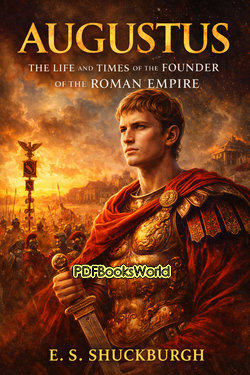
Augustus: The Life and Times of the Founder of the Roman Empire
by E. S. Shuckburgh
The Rise of Rome's First Emperor and the Birth of an Empire
Augustus: The Life and Times of the Founder of the Roman Empire by E. S. Shuckburgh is a detailed historical biography of the man who transformed Rome from a republic torn by civil war into a stable and enduring empire. Through an examination of political events, military campaigns, and personal leadership, the book traces the remarkable career of Augustus and the foundations he laid for centuries of Roman rule.
From Octavian to Augustus
Born as Gaius Octavius, the future Augustus rose to prominence following the assassination of his great-uncle, Julius Caesar. Though young and initially underestimated, he skillfully navigated a dangerous political landscape marked by rival factions, military conflict, and shifting alliances. Over time, he emerged as the dominant figure in the Roman world.
His transformation from ambitious heir to imperial ruler is one of history's most remarkable political stories.
Major Subjects Covered
- The Fall of the Roman Republic: The political crises that preceded Augustus's rise.
- Civil Wars: Conflicts that determined control of the Roman state.
- Imperial Government: The creation of new political institutions.
- Military Leadership: Campaigns that secured Roman power.
- Cultural Development: The flourishing of literature, architecture, and public life.
The Struggle for Power
The book recounts the turbulent years following Caesar's death, when competing leaders sought control of Rome. Augustus demonstrated exceptional political skill, forming alliances when necessary and confronting rivals when circumstances demanded. His eventual victory brought an end to decades of instability.
These events shaped the future of the Mediterranean world.
The Creation of the Roman Empire
Rather than openly abolishing republican traditions, Augustus carefully reshaped existing institutions while concentrating authority in his own hands. This approach allowed him to establish lasting stability while preserving the appearance of continuity.
The resulting system became the foundation of the Roman Empire.
Leadership and Reform
Augustus introduced reforms affecting administration, taxation, military organization, and public order. His policies helped strengthen government efficiency and promote long-term stability throughout Roman territories.
Many of these reforms influenced the empire for generations.
The Augustan Age
The reign of Augustus is often regarded as a golden age of Roman culture. Writers, poets, architects, and artists benefited from the relative peace and prosperity of the period. Monumental building projects transformed Rome, while literature flourished under imperial patronage.
The era left a lasting mark on Western civilization.
E. S. Shuckburgh's Historical Approach
Shuckburgh presents Augustus not merely as a conqueror or politician but as a complex statesman whose decisions reshaped the ancient world. By combining political history with biographical detail, he offers readers a comprehensive portrait of the emperor and his age.
The book balances narrative storytelling with historical analysis.
Why Augustus Remains Important
Augustus's influence extended far beyond his lifetime. The governmental structures he established endured for centuries, while his reign became a model for later rulers. His success in restoring stability after prolonged conflict continues to attract the attention of historians and political thinkers.
Understanding Augustus is essential to understanding Roman history.
A Compelling Portrait of Rome's First Emperor
Augustus: The Life and Times of the Founder of the Roman Empire offers a rich account of one of history's most influential leaders. Through discussions of political strategy, military achievement, administrative reform, and cultural development, E. S. Shuckburgh illuminates the life of the man who laid the foundations of imperial Rome. The book remains a valuable resource for readers interested in ancient history, leadership, and the transformation of civilizations.
Similar Genres
About the Author
E. S. Shuckburgh, or Evelyn Shirley Shuckburgh, was an English classical scholar, historian, translator, and educator whose writings made the history and literature of ancient Greece and Rome accessible to generations of readers. Explore E. S. Shuckburgh books to discover the author's life, literary career, and access notable works.