
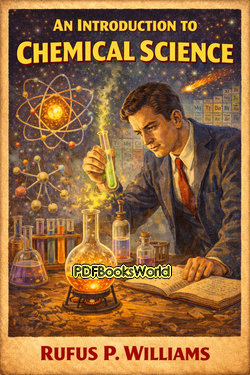
An Introduction to Chemical Science
by Rufus P. Williams
Foundations of Chemistry, Scientific Observation, and the Study of Matter
An Introduction to Chemical Science by Rufus P. Williams is an educational work designed to introduce students and general readers to the basic principles, methods, and discoveries of chemistry. Written during a period when scientific education was expanding rapidly, the book explains the composition and behavior of matter through clear instruction, practical experimentation, and systematic scientific reasoning.
Williams presents chemistry as a logical and experimental science that reveals the hidden structure of the material world while emphasizing the importance of observation, laboratory work, and careful analysis.
A Beginner’s Guide to Chemical Understanding
The book introduces essential concepts including atoms, elements, compounds, chemical reactions, acids, bases, gases, heat, and molecular structure. Williams explains how substances interact, combine, and transform according to consistent scientific laws.
Rather than overwhelming readers with advanced mathematics or highly technical theory, the work focuses upon building a strong conceptual foundation through simple explanation and practical examples.
The volume also emphasizes the role of experimentation in scientific learning, encouraging students to observe chemical changes directly and understand how evidence supports scientific conclusions.
Its tone combines educational clarity with scientific curiosity and practical instruction.
The Importance of Laboratory Investigation
A central idea throughout the book is that chemistry must be understood through experimentation as well as theory. Williams repeatedly stresses the importance of observation, testing, and precise measurement within scientific study.
The work reflects the growing importance of laboratory-centered education during the late nineteenth and early twentieth centuries, when chemistry became increasingly connected to medicine, manufacturing, agriculture, and industrial science.
By encouraging practical engagement with chemical processes, the book helped make scientific learning more active and accessible for students.
Scientific Topics Explored Throughout the Book
- Atoms, Elements, and Compounds: Williams explains the structure and classification of matter.
- Chemical Reactions and Transformations: The book examines how substances combine and change through measurable processes.
- Laboratory Observation and Experimentation: Scientific understanding is developed through practical investigation and evidence.
- Heat, Gases, and Solutions: Important chemical and physical processes are explained through accessible examples.
- Scientific Method and Reasoning: The work emphasizes logic, measurement, and observation as foundations of chemistry.
The book reflects broader efforts to make scientific education more systematic and widely available.
Chemistry and Everyday Life
One of the work’s strongest ideas is that chemistry is closely connected to ordinary experience and practical human activity.
Williams demonstrates how chemical principles influence cooking, cleaning, combustion, medicine, manufacturing, agriculture, and countless everyday processes.
The book also emphasizes that scientific understanding allows humanity to use natural materials more intelligently and effectively.
This practical approach helped readers appreciate chemistry not merely as an abstract science, but as an important part of modern civilization.
Rufus P. Williams’ Clear Educational Style
An Introduction to Chemical Science demonstrates Rufus P. Williams’ ability to explain scientific concepts in straightforward, organized, and accessible language suitable for beginning students.
The writing remains methodical, informative, and strongly focused upon gradual learning through explanation and experiment.
Williams consistently presents chemistry as a science open to careful observation, disciplined thinking, and intellectual curiosity.
Why the Book Still Holds Historical and Educational Interest
Modern readers continue finding An Introduction to Chemical Science historically valuable because it reflects how chemistry was introduced to students during an important stage in the development of modern science education.
The book also provides insight into early teaching methods surrounding atomic theory, laboratory practice, and chemical reasoning before later scientific advances transformed chemistry and physics.
Its emphasis on observation, experimentation, and logical analysis continues to reflect many of the core principles underlying scientific education today.
For readers interested in chemistry, scientific education, laboratory science, history of science, chemical theory, and early scientific textbooks, this work remains educational, historically revealing, and intellectually engaging.
Similar Genres
About the Author
Rufus P. Williams was an American chemist, educator, and author who dedicated his career to making chemistry understandable for students and general readers. He believed that scientific knowledge should be built through observation, experimentation, and logical reasoning rather than memorization alone. Explore Rufus P. Williams books to discover the author's life, literary career, and access notable works.