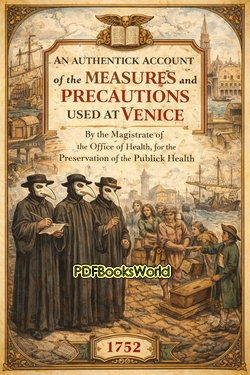
An Authentick Account of the Measures and Precautions Used at Venice
by Anonymous
A Historical Examination of Public Health and Epidemic Control in Early Modern Venice
An Authentick Account of the Measures and Precautions Used at Venice is a fascinating historical document describing the public health policies and preventive measures employed by the Republic of Venice during times of epidemic disease. Written in an era when outbreaks of plague and other contagious illnesses posed a constant threat to European cities, the work provides valuable insight into one of history’s most sophisticated systems of disease prevention and quarantine.
Long before the development of modern germ theory, Venetian authorities recognized the importance of isolation, regulation, inspection, and careful monitoring of trade and travel. As a major commercial center connecting Europe with the Mediterranean and the East, Venice faced unique challenges in protecting its population while maintaining economic activity.
The book serves as both a practical account of public policy and a historical record of how governments attempted to combat disease before the rise of modern medicine.
The volume blends public health history, civic administration, and social observation.
Venice and the Challenge of Epidemic Disease
Throughout the medieval and early modern periods, Venice was one of Europe's busiest trading powers. Ships arrived constantly from distant ports, bringing valuable goods but also the risk of infectious disease.
To address these dangers, Venetian officials developed a remarkably organized health system that became influential across Europe.
Measures described in the work likely include:
- Quarantine requirements for ships and passengers.
- Inspection of incoming cargo and merchandise.
- Isolation facilities for suspected cases.
- Health certificates and travel documentation.
- Regulations governing movement within the city.
These policies reflected an understanding that disease could spread through human contact and commercial networks, even if the precise biological mechanisms remained unknown.
The Venetian System of Quarantine
One of Venice’s most important innovations was the establishment of quarantine procedures. The very word “quarantine” derives from practices requiring individuals or vessels to remain isolated for a designated period before entering the city.
Authorities sought to balance two competing priorities:
- Protecting public health.
- Preserving commerce and trade.
This balancing act required careful administration and strict enforcement. Officials monitored arrivals, investigated reports of illness, and imposed restrictions when necessary.
The account likely highlights how these measures were organized and implemented in daily practice.
The Style and Purpose of the Work
The anonymous author writes in a factual and descriptive manner, aiming to document procedures rather than provide dramatic narrative. The work appears designed to inform readers about Venetian methods and perhaps encourage similar policies elsewhere.
Its tone is practical, emphasizing observation, administration, and public welfare.
Because epidemic disease affected entire societies, such accounts held significant value for governments, physicians, merchants, and travelers seeking reliable information about successful preventive strategies.
Main Themes and Historical Reflection
The book explores several interconnected themes:
- Public health: Protecting populations from epidemic disease.
- Government administration: Organizing effective responses to crises.
- Trade and security: Balancing economic activity with safety.
- Prevention: Reducing risk before outbreaks spread.
- Collective responsibility: The role of society in safeguarding public welfare.
These themes demonstrate that many challenges associated with disease management have deep historical roots.
Why the Work Still Holds Importance
An Authentick Account of the Measures and Precautions Used at Venice remains historically valuable because it documents one of the earliest and most advanced public health systems in Europe.
Modern historians frequently study Venetian quarantine practices as important milestones in the development of organized health policy and epidemic management.
The work also reveals how societies confronted uncertainty and risk long before modern scientific medicine transformed public health.
Its detailed observations continue to provide insight into the practical realities of disease prevention in the early modern world.
The Lasting Legacy of Venetian Public Health
Venice became a model for other European states seeking to combat epidemic disease. Its health boards, quarantine stations, and inspection systems influenced public health policies far beyond the city itself.
Many principles associated with modern disease control—including monitoring, isolation, and preventive regulation—have historical connections to practices developed centuries earlier.
The continuing study of medical history and epidemic response helps preserve appreciation for documents such as this one.
Final Thoughts
An Authentick Account of the Measures and Precautions Used at Venice is an informative and historically significant account of how one of Europe’s great commercial republics sought to protect its citizens from epidemic disease. Through careful description of quarantine systems, administrative procedures, and preventive policies, the work offers a valuable glimpse into the origins of organized public health.
For readers interested in medical history, public administration, Venetian history, and the development of epidemic control, this work remains both enlightening and remarkably relevant.