
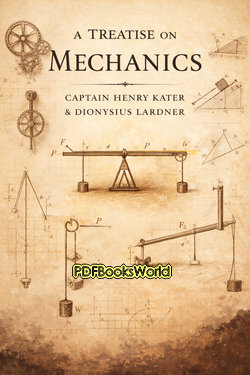
A Treatise on Mechanics
by Henry Kater
A Foundational Study of the Laws of Motion and Force
A Treatise on Mechanics by Henry Kater is a classic scientific work that introduces the principles governing motion, force, equilibrium, and mechanical systems. Written during a period when the physical sciences were becoming increasingly systematic and mathematical, the book was intended to provide students and scholars with a clear understanding of the fundamental laws that explain how objects move and interact.
Drawing upon the achievements of earlier scientists such as Isaac Newton, the treatise presents mechanics as a logical and unified branch of natural philosophy. Through definitions, demonstrations, and practical examples, Kater explains how mathematical principles can be applied to understand the behavior of bodies both at rest and in motion.
The work stands as an important example of scientific education in the nineteenth century.
The Science of Mechanics
Mechanics is the branch of physics concerned with the effects of forces on objects. It seeks to explain why bodies remain at rest, move in straight lines, accelerate, or change direction.
Kater introduces readers to the fundamental concepts that form the basis of mechanical science. These include force, mass, velocity, momentum, and acceleration. By examining the relationships among these ideas, the treatise establishes a framework for understanding a wide range of physical phenomena.
The subject serves as one of the foundations upon which much of modern physics and engineering is built.
Newtonian Principles
A major portion of the book is devoted to the laws of motion developed by Isaac Newton. These principles provide a systematic explanation of how forces influence movement and remain central to classical mechanics.
One of the most important relationships discussed is:
This equation expresses the idea that force produces acceleration in proportion to an object's mass. Such principles allow scientists and engineers to analyze everything from falling objects to complex machines.
Kater carefully explains these concepts to make them accessible to learners.
Statics and Equilibrium
In addition to motion, the treatise examines the conditions under which objects remain at rest. This branch of mechanics, known as statics, studies balanced forces and stable structures.
Topics explored include:
- The equilibrium of forces.
- Levers and mechanical advantage.
- Centers of gravity.
- The stability of structures and systems.
These principles are essential for architecture, engineering, and many practical applications involving physical design.
Machines and Mechanical Advantage
Kater devotes considerable attention to simple machines and their operation. Devices such as levers, pulleys, wheels, and inclined planes demonstrate how force can be applied efficiently to accomplish work.
By studying these systems, readers gain insight into the mechanical principles underlying more complex technologies. The treatise shows how relatively simple ideas can be combined to produce powerful practical results.
This connection between theory and application was a key feature of scientific education during the period.
Mathematics as a Tool of Understanding
One of the distinguishing characteristics of the work is its reliance on mathematical reasoning. Kater emphasizes that physical laws can often be expressed through precise relationships and calculations.
Rather than treating mathematics as an abstract subject, he presents it as a practical tool for analyzing real-world problems. Measurements, proportions, and geometric principles all contribute to a deeper understanding of mechanical systems.
This approach reflects the increasing importance of quantitative methods in nineteenth-century science.
Henry Kater's Contribution
Henry Kater was a distinguished British physicist and mathematician known for his work in precision measurement and scientific instrumentation. His expertise in experimental science informed his educational writings, helping him present complex ideas in a clear and systematic manner.
Through this treatise, Kater contributed to the dissemination of scientific knowledge and supported the education of students entering technical and scientific fields.
His work helped make the principles of mechanics more accessible to a wider audience.
Historical and Educational Importance
Today, A Treatise on Mechanics remains valuable as both a scientific text and a historical document. It illustrates how mechanics was taught during a formative period in the development of modern science and engineering.
Many of the principles discussed continue to form part of introductory physics courses. Although scientific education has evolved considerably, the foundational concepts of force, motion, and equilibrium remain unchanged.
The book therefore offers insight into both the history of science and the enduring nature of physical laws.
Final Thoughts
A Treatise on Mechanics by Henry Kater is a comprehensive introduction to the principles that govern motion, force, and mechanical systems. Through clear explanations, mathematical reasoning, and practical examples, the work provides readers with a strong foundation in one of the most important branches of physical science.
For students of physics, engineering, the history of science, and classical scientific literature, this treatise remains a significant and enlightening exploration of the laws that shape the physical world.
Similar Genres
About the Author
Henry Kater was a British physicist, military officer, surveyor, and scientific author whose work made lasting contributions to mechanics, metrology, and geodesy. Best remembered for his precise scientific measurements and the invention of the reversible pendulum used to determine the acceleration due to gravity, Kater combined practical engineering skills with careful experimentation. Explore Henry Kater books to discover the author's life, literary career, and access notable works.