
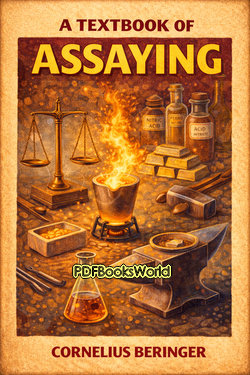
A Textbook of Assaying
by Cornelius Beringer
Metallurgy, Precious Metals, and the Science of Chemical Analysis
A Textbook of Assaying by Cornelius Beringer is a technical and scientific work devoted to the methods of assaying, the process through which ores, metals, and mineral substances are analyzed to determine their composition and commercial value. Written during the growth of industrial mining and metallurgy, the book reflects the increasing importance of chemistry, precision measurement, and laboratory analysis within mining, engineering, and metal production.
Beringer presents assaying as both a scientific discipline and a practical industrial skill requiring accuracy, technical knowledge, and careful experimentation.
The Scientific Analysis of Metals and Ores
The book explains the laboratory methods used to test and measure valuable metals such as gold, silver, copper, lead, and other mineral substances. Beringer discusses furnace techniques, chemical separation, weighing, sampling, and analytical procedures used in mining laboratories and metallurgical industries.
He emphasizes that accurate assaying is essential for determining the economic value of ores and ensuring reliable industrial production.
Rather than treating metallurgy as purely mechanical labor, the work demonstrates how chemistry and quantitative analysis became central to modern mining operations and metal refining.
The volume also reflects the rapid industrial expansion of the nineteenth and early twentieth centuries, when scientific methods increasingly transformed extraction industries and manufacturing.
Its tone combines practical instruction with scientific precision and industrial experience.
The Importance of Precision in Assaying
A major theme throughout the book is that even small errors in measurement or laboratory procedure can significantly affect the value and interpretation of mineral samples.
Beringer repeatedly stresses careful weighing, accurate calculation, proper handling of equipment, and disciplined experimentation as essential parts of professional assaying work.
The work also demonstrates how scientific analysis helped replace unreliable estimation methods with more exact laboratory techniques capable of supporting industrial development and commercial trade.
This emphasis on accuracy and consistency reflects the broader scientific transformation of industrial practice during the modern era.
Scientific and Industrial Topics Explored Throughout the Book
- Gold and Silver Assaying: Beringer explains methods for analyzing precious metals and determining their purity.
- Chemical Analysis of Ores: The book examines laboratory techniques used to study mineral composition.
- Metallurgy and Industrial Chemistry: Scientific methods are connected to mining, refining, and metal production.
- Laboratory Equipment and Experimental Procedure: Accurate instruments and careful methods are presented as foundations of reliable analysis.
- Quantitative Measurement and Scientific Precision: The work emphasizes exact calculation and disciplined laboratory practice.
The book reflects the increasing professionalization of mining science and industrial chemistry during the industrial age.
Assaying and the Growth of Industrial Civilization
One of the work’s strongest ideas is that modern industry depends heavily upon scientific analysis and precise understanding of natural materials.
Beringer repeatedly demonstrates how advances in chemistry and metallurgy improved the efficiency, profitability, and reliability of mining operations.
The book also reveals how laboratory science became closely connected to economic development, engineering, and global industrial expansion.
This combination of chemistry and industrial application gives the work lasting historical significance.
Cornelius Beringer’s Technical and Educational Style
A Textbook of Assaying demonstrates Cornelius Beringer’s ability to combine scientific explanation with detailed practical instruction suitable for students, laboratory workers, and industrial professionals.
The writing remains methodical, informative, and strongly focused upon developing technical understanding and laboratory competence.
Beringer consistently presents assaying as a disciplined science requiring patience, precision, and technical expertise.
Why the Book Still Holds Historical and Scientific Interest
Modern readers continue finding A Textbook of Assaying valuable because it documents the laboratory methods and industrial practices that shaped modern metallurgy and mining science.
The book also provides insight into how chemistry became increasingly important within industrial production before modern electronic instruments and automated analytical systems transformed laboratory work.
Its detailed treatment of mineral analysis, laboratory procedure, and metallurgical science offers an important historical perspective on the relationship between chemistry, engineering, and industrial development.
For readers interested in chemistry, metallurgy, mining history, industrial science, laboratory analysis, and the history of engineering, this work remains technically informative, historically revealing, and intellectually engaging.
Similar Genres
About the Author
Cornelius Beringer was an English analytical chemist, mining specialist, educator, and author whose work made a significant contribution to the teaching of assaying and mineral analysis. He specialized in the chemical examination of ores, metals, and minerals, helping students and professionals understand the techniques required to determine their composition and value. Explore Cornelius Beringer books to discover the author's life, literary career, and access notable works.